PolitiClone
Political Pundits? India
Showing posts with label Bahujan Samaj Party. Show all posts

Mayawati under fire for slapping Dalit Act on TV scribes

7:05 AM
Lucknow, Sep 10 :  Uttar Pradesh Chief Minister Mayawati has come under fire from media persons and the opposition for slapping the Dalit Act on reporters of a national TV channel for a news report on how a starving Dalit sold off his wife in the poverty-hit Bundelkhand region of the state.

The Uttar Pradesh Accredited Press Correspondents Committee has vehemently condemned the government’s move to haul the IBN-7 channel and its scribes over the stringent provisions of the Dalit Act.

Samajwadi Party president and former chief minister Mulayam Singh Yadav termed the move as draconian and anti-democratic.

“What the TV channel reported was harsh reality and the media must have the freedom to show the truth in a democracy,” Mulayam Singh told reporters here.

He added, “But through her vindictive action, she has proved that she does not believe in democratic values at all and instead her intent was to intimidate the media so that it remains under her thumb.”

Mulayam Singh said: “I challenge her to take action against me as I still maintain that the Dalit woman was sold away so that her family could get four square meals.”

He also flayed the state Women’s Commission for “manipulating facts in its bid to disprove the report”.

The Women’s Commission that took the lead in contradicting the TV expose is headed by the sister of Mayawati’s blue-eyed lieutenant Satish Chandra Misra, the ruling Bahujan Samaj Party (BSP)’s Brahmin mascot.
Read On

EC puts Maya on notice for elephants in memorials

6:24 AM
The Election Commission of India (ECI) has served a notice to the Bahujan Samaj Party (BSP) for allegedly using money from the state exchequer for building and installing statues of the elephant, which is the election symbol of the BSP.

The ECI notice follows a petition filed by advocate Ravi Kant and a letter sent to the ECI by a social organisation, Common Cause. BSP president Mayawati has been asked to send her reply by August 12.

In his petition to the ECI, which was submitted on July 18, Ravi Kant had written that public money is being misused in Uttar Pradesh to place the images of the election symbol of the BSP in public places.

The petition urged the Commission to stop this violation of the model of conduct by the UP government in view of the Assembly by-election in Malihabad, which is being held later this month.

“This is a serious violation of the Model Code of Conduct. Also, public money from the state exchequer has been spent to build statues of Mayawati,” Ravi Kant said in his petition.

Ads by Google Call India for 2.5 ¢/min The Only Clean Card to Call India. No Gimmicks, No Games Buy one now!www.DIAL91.comFly With Air India Get Great Deals on Flight Tickets Only @ India's No-1 Travel Website!MakeMyTrip.Com/CheapAir India Chicago to DEL Find Low Fares & Great Deals On Air India Airline Chicago to DelhiGlobeTravels.com/Chi

The petitioner also said that the Election Commission had, on April 1, 2009, ordered that “photographs of prime minister, chief ministers, ministers and other political functionaries should not be displayed” in view of the elections.

“By installing her own statues and also statues of elephant in all memorials and parks, the chief minister is openly publicising her party symbol and that too, permanently,” Ravi Kant told The Indian Express.
Read On

Mayawati’s Idolization and quest for Dalit Emancipation

2:03 AM
By SR Darapuri

During the Assembly elections 2007, the people of Uttar Pradesh (U.P.) India and especially the Dalits voted Mayawati’s Bahujan Samaj Party (BSP) to absolute majority. They expected that this time with a stable government she will be able to take U.P. out of the quagmire of underdevelopment and backwardness. They also hoped that now she will work out a development agenda for the State as well as for the Dalits and implement it faithfully. During her previous three stints as Chief Minister she took the plea that due to her dependence on other parties for support she could not act independently. As such she needed a government with majority to give her a free hand in running her government. But even this time Mayawati did not come up to the people’s expectations. Neither she neither worked out development agenda nor stopped wasting public money on installing statues, creating memorials and making parks.

If judged from the point of view of development, at present U.P. is the one of the most backward states of India. As per 2001 Census Repot it has the largest population (16.16 crores) which stands as 16.16 % of total population of India. According to development parameters the total literacy rate of U.P. is 56.30 % (Male 68.8 and Female 42.2 %) whereas at the national level it is 68.84 % (Male 75.26 and 53.67 %). The sex ratio of U.P. stands at 898 whereas the national ratio is 933. According to available statistics the per capita income in U.P. during 2005-06 was Rs. 13,316 which is the lowest in the country excepting Bihar (Rs. 7875) whereas at the national level it is Rs. 25,716. During this period the per capita power production and consumption in U.P. was 113 and 167 K.W.Hour as compared with 563 and 372 K.W.Hour at the national level.

From the Public Health angle the birth rate, death rate and child mortality rate for U.P. were 30.4, 8.7 and 73 respectively whereas the national rates were 23.8, 7.6 and 58 respectively. As per the findings of NFHS-III, 2005-06 the infant mortality (number of infant deaths per thousand live births in the last five years) rate at national level is 57 whereas for U.P. it is 73. In India, 46 per scent children under three yeas of age are underweight whereas in U.P. it is 47 percent. Almost 38 % children (under three years age) are stunted (too short for their age). In U.P. their percentage is 46. Almost 79 % of children (6-35 months) and 56 % of women in India are anemic. In U.P. the figures are 85 and 51 percent respectively. From the employment angle during 2001 in U.P. only 23.78 % of total workers were Main Workers and 66 % were engaged as Agriculture Labourers. At present 32 % of U.P. population is living below poverty line against the national average of 27.5 percent.

From the above details it is clear that from the development point of view U.P. is one of the most backward states of India. In such a situation, not only Mayawati but every government is expected to utilize all the resources of the State for the development of the people. But it has not happened for last many years. According to Sudha Pai “There is evidence that the conditions of the poorer sections in U.P. which include the major chunk of the Dalits have become worse during the 1990s. The National Human Development Report (NHDR) has pointed out the poor conditions of life in comparison with many other states. The State’s position in terms of Human Development Index was 29th in 1981 and has fallen to 31 out of 32 states (NHDR 2001:140-41). Similarly the Monthly Per Capita Consumption Expenditure registered a fall in the State between 1993-94 and 1999-2000; that this is due to a drastic reduction in the consumption expenditure on food between two periods clearly suggest deterioration in the standard of living. This down slide took place when the B.S.P. supported by B.J.P. was in power in U.P. for the most part (National Herald, Lucknow May 1, 2002). Despite the fact that the BSP. had formed a government twice during the 1990s and was again in power with the support of the Bhartiya Janta Party, the conditions of Dalits have not improved according to the draft proposals of the Tenth Five Year Plan (Jha, 28 December, The Times of India, New Delhi-2002). The BSP did not put forward any policies for improving the socioeconomic conditions of the subaltern sections of the Dalits. The emphasis has been on political empowerment only.”

It is well known that Mayawati did not take up any development agenda during all her tenures of Chief Minister ship. During the elections BSP never came out with an election manifesto. This was done purposely. Because declaration of an agenda being about the responsibility of implementing it and failure to do so invites public wrath. Mr. Kanshi Ram, the mentor of Mayawati, attracted Dalits by promising to fulfill the incomplete mission of Dr. Ambedkar but cleverly he never defined it in writing. “First capture political power and then any work” was the promise given by BSP. In the beginning, Dalits were instigated against higher castes by raising emotional and non-material issues but later on all sorts of unprincipled and opportunistic alliances were made to get political power. All the principles of Ambedkarism were thrown to winds and dalits were exploited emotionally in the name of caste. Personal ambitions were pursued in place of Dalit issues. This unprincipled, non developmental and corrupt politics has resulted in poverty, unemployment and backwardness of the people of U.P. and the Dalits at large.

Now it will be pertinent to see on what items the budget money was spent during this period. It has been found that major part of budget was spent on non-development projects. It is noticeable that 90 % of Cultural Department and about 40 % of Public Works Department budget was spent on parks, memorials and statues. What ever money was spent on welfare programmes, a major apart of it was eaten away by corruption. As such the poor were deprived of any benefit there of. The main cause of it has been the personal greed and corruption of Mayawati which may land her in jail in the near future. She has spent a major portion of state budget on installing statues, making parks and creating memorials. Along with the statues of Dr. Ambedkar and some other Dalit icons she has installed her own statues along with her mentor Kanshi Ram. She seems to have taken inspiration from North Korean dictator Kim Jong-Ill. She has made history by installing her own statues as a living person. According to available information she has spent more than 3,000 crores of Rupees on statutes and parks. These statues and memorials are so grand and costly which can put any king or queen to shame. According to one German scholar Maren Schempp, “Mayawati is building her own Rome.” Another scholar has labeled it as a criminal waste of public money.

Now Mayawati is ruling the State for the fourth time and she proclaims to be the savior of Dalits. In the face of this claim it will be proper to see what she has done to for the upliftment of Dalits of U.P. According to 2001 Census Report the population of Dalits in U.P. is 3.51 crores which is 21.2 % of State population and is the largest in whole of India. Ordinarily it is expected that in a state where a Dalit Chief Minister has occupied the chair for the fourth time, the Dalits of that state might have benefited much from her rule. But the ground reality is totally to the contrary. At present U.P. dalits are the most backward in whole of India leaving aside the Dalits of Orissa and Bihar. According to 2001 Census Report the Male- Female sex ratio of U.P. dalits is 900 whereas the national average of Dalits is 936. Similarly the literacy rate of U.P. Dalits is 46.3 % (Male 60.3 and Female 30.5 Percent) against the national average of 54.7 percent (Male 66.6 and Female 41.9 %). According to above Census report out of 1.33 crore children between the age of group 5-14 yeas only 58.3 lacs ( 56.4 % ) were going to school.

According to above census Report among total workers U.P. has got 42.5 % dalits working as Agriculture Labourers against the national average of 45.6 %. The percentage of U.P. dalits below poverty line is about 50 %. In U.P. Work Participation Rate of Dalits is 34.7 % which is lower than the national average. Being a dominantly agriculture based society land is an important source of production. In U.P. the number and size of land holdings with dalits is very small but land reforms have not been given proper priority in the State. What ever land was given to the landless, most of it is under illegal possession of higher castes and Mayawati cannot afford to annoy them as they form an important part of her Sarvjan (all included) followers.

On account of feudal social set up caste discrimination and practice of untouchability are the main factors behind atrocities against Dalits in U.P. Their number is highest in whole of India. A decrease in atrocities and prompt action against the offenders is the general expectation from Mayawati but the reality is totally otherwise. During 2001 Mayawati in order to keep her crime figures low issued a written order suspending the use of Scheduled Cases and Scheduled Tribes (Prevention of Atrocities ) Act but was forced to withdraw the same in 2003. This had a very adverse effect on dalits. The atrocities continued to be perpetrated but their cases were not being registered by police. Besides this, the practice of untouchability is quite prevalent in midday meals in Primary Schools, Anganwari Centres and government hospitals but very little action is taken at government level. Thus Dalits continue to suffer under Mayawati’s rule. They have not experienced any empowerment material or otherwise.

“The statues serve as a source of inspiration for dalits” is the argument put forward by Mayawati for justifying her idolization. But this argument is quite contrary to the philosophy of Dalit icons. Let us see what Dr. Ambedkar said in a letter published in Bombay Chronicle in 1916. Following the death, in 1915, of Pherozeshah Merwnjee Mehta, one of the founders of Indian National Congress, and of Gopal Krishana Gokhle, another Congress leader and founder of Servants of India society, Ambedkar notes: “The memorial for Gokhle is to take the form of establishing branches of Servants of India Society at various places, while that of Sir P.M. Mehta is to stand in the form of a statue before the Bombay Municipal Office.” While appreciating the memorial for Gokhle, Ambedkar records his dismay over a statue for Mehta being “very trivial and unbecoming.” He is “at pains to understand why this memorial cannot be in a form that will be “of permanent use to posterity.”. He suggests that the memorial should be a public library named after Mehta. Drawing from his experience at “one of the biggest universities in the U.S., Ambedkar laments how we have not yet “realized the value of the library as an institution in the growth and advancement of society.”

Later, Dr. Ambedkar acted on these principles when he had the opportunity. He was driven by the belief that education was the greatest weapon for advancement. He founded “People’s Education Society” in 1944; three branches of Siddharth College beginning 1946; and Milind Mahavidhyalya in 1950. With a view to benefit the maximum number of students he established colleges in Bombay and Marathwar which is the most backward area in Maharashtra.

It is true that statues serve as source of inspiration but this role is very limited. The lasting inspiration comes by following their ideals and propagating their philosophy. But Mayawati has done hardly any thing in this direction. If the money spent on statues had been spent in establishing educational institutions in the name of dalit icons, it would have brought a qualitative change in the society.

From the brief above discussion it transpires that the emancipation of dalits can be achieved not by installation of statues but by working out a Dalit development agenda and implementing it honestly. In stead of spending crores on the statues, establishing educational institutions, hospital, libraries and useful institutions in the name of Dalit icons will be a true honour and memorial to them.

SR Darapuri, is a retired Indian Police Service (IPS) officer (former Inspector General (IG) of Police), Vice-President of People's Union for Civil Liberties (PUCL), UP, and also represents the National Alliance of People's Movements (NAPM) and Lok Rajniti Manch (People's Politics Front). Email: srdarapuri@yahoo.co.in
Read On

In UP, Mayawati and Mulayam’s loss is Congress’ gain

1:38 AM
New Delhi: Bahujan Samaj Party (BSP) president and Uttar Pradesh chief minister Mayawati’s prime ministerial ambitions received a rude jolt on Saturday after her party managed to win or was leading in just 20 seats in the general election, half the 40 it had expected.
Dashed hopes: BSP’s poor showing in Uttar Pradesh means chief minister Mayawati has to put her prime ministerial ambitions on hold. Nand Kumar / PTI
Some experts see the outcome of the elections in Uttar Pradesh, India’s most populous state, as a sign of the BSP’s fading appeal for Dalits, who are at the bottom of the caste pyramid and constitute the party’s main vote base. Even Muslims, seeking an alternative to the BSP’s main rival, the Samajwadi Party (SP), seem to have preferred to vote for the Congress rather than the BSP, the experts said.

Mayawati, who had aspired to become prime minister as a key member of the so-called Third Front, a non-Congress, non-Bharatiya Janata Party (BJP) political formation, led the BSP to power in Uttar Pradesh two years ago when the party managed to secure a majority in the state assembly on its own.

“The BSP is faced with some erosion in its Dalit vote bank. This is particularly true of the Dalits other than Jatavs (who form the core of the BSP vote), who have started drifting away from the party,” said Praveen Rai, a psephologist at the Delhi-based Centre for Study of Developing Societies.

Rai also said that the party could not attract Muslim voters, who have clearly moved away from the SP to the Congress. Mayawati’s social engineering skills, which attracted the upper castes to the predominantly Dalit party in the last assembly elections, had not really worked this time, he added.

Dalit writer Chandra Bhan Prasad also said the BSP may have begun to lose Dalit votes. “People have a grouse with the BSP on account of the lack of development in the state,” Bhan said. “They are looking at the hundreds of Ambedkar statues that have come up around the state and saying to themselves: ‘what a colossal waste of money.’”

BSP is facing an erosion in its Dalit vote bank that constitutes the party’s main vote base, say experts
That’s a reference to B.R. Ambedkar, the architect of the Indian Constitution and a Dalit icon.
 
A senior BSP leader said the party had expected to win at least 40 seats during a review a couple of months ago. “It is too early to say what was lacking in our programme,” added the BSP leader, who didn’t want to be identified. He admitted that the party would be forced to take a political back seat on account of the “superlative” performance by the Congress in Uttar Pradesh. “There does not seem to be much work for the Third Front at the moment,” he conceded.

The Congress won or was leading in 21 seats in Uttar Pradesh, raising its tally from nine in 2004.

The BSP won 19 seats and 24% of the votes polled in Uttar Pradesh in the 2004 Lok Sabha elections; its vote share rose to to 30.43% in the 2007 assembly elections. The SP won or was leading in 23 seats, down from its tally of 35 in 2004.

Meanwhile, the main reason for the SP’s decline is a waning of its appeal for the Muslims, experts said. A section of the party’s Muslim leadership was estranged from the party after SP chief Mulayam Singh Yadav offered a party ticket to former chief minister Kalyan Singh’s son.

Kalyan Singh, then with the BJP, was the Uttar Pradesh chief minister when the disputed Babri mosque was demolished by Hindu vandals in December 1992.

A feud between SP general secretary Amar Singh and senior leader Azam Khan may also have alienated Muslims.

The SP will decide on Sunday whether to support a United Progressive Alliance (UPA) government at the Centre in case the alliance falls short of a majority. “Our parliamentary board will meet tomorrow (on Sunday) and decide our future strategy,” Mulayam Singh Yadav told reporters in Lucknow.
 
The SP supported the Congress-led UPA government after the Left in July withdrew its support to the ruling coalition to protest the government’s decision to go ahead with the Indo-US civilian nuclear deal. The SP and the Congress failed to reach a pre-election seat-sharing agreement in Uttar Pradesh.

Asked about the party’s dwindling strength in the Lok Sabha, Yadav said: “We accept the verdict of the people with humility. We are not worried at all.” On arch-rival BSP’s performance in Uttar Pradesh, he said: “I do not consider it as our competitor.”
Read On

BJP, SP try to win over Brahmins with Mayawati’s words

3:35 AM
mayawati4 300x211 BJP, SP try to win over Brahmins with Mayawatis words
Uttar Pradesh Chief Minister Mayawati’s rivals - the Samajwadi Party (SP) and the Bharatiya Janata Party (BJP) - are using her words to dent her winning Dalit-Brahmin electoral formula.

With the Lok Sabha polls on, both these parties have been trying to convince upper caste voters, particularly Brahmins, of a loss in social status if they continue to back Mayawati’s Bahujan Samaj Party (BSP).

Picked up first by the SP and soon after by the BJP, page number 154 of the first part of Mayawati’s autobiography mentions the BSP philosophy of “Lutiya, Khatiya and Bitiya” — this is now being projected as a threat to Brahminical caste hierarchy.

The philosophy means sharing water from the same jug, sitting together on the same cot and marriage between various castes.

SP chief Mulayam Singh Yadav prominently highlighted this philosophy at his rally in Gonda April 22.
“Mayawatiji has stated on page number 154 that untouchables are being offered water, a place to sit along with the upper castes who may even agree to marry their daughters with Dalits if they stay with the BSP,” Mulayam Singh said at the rally.

The BJP was quick to follow.

“We received huge consignments of photocopies of the page from our headquarters with instructions to distribute it on a war footing. We are already campaigning to spread awareness here as well as in adjoining areas,” said Mahesh Tiwari, a block level leader of the party in Gonda.

The Brahmin votebank helped Mayawati swing into power with full majority in Uttar Pradesh two years ago. Out of the 206 seats she won, 42 winning candidates were Brahmins - she gave tickets to 86 Brahmin candidates.

BSP’s Brahmin face and the party’s number two, Satish Chandra Mishra, said in an interview recently: “Our core vote is intact and is spread across 55 seats out of the 80 constituencies of the state.”

A senior BSP leader said: “A major chunk of this core vote constitutes of Dalit and upper caste vote. Now, we need to supplement this with votes from other communities and this is happening across the state in about 40 to 50 seats.”

However, political experts call this a pure political gimmick of the BJP and SP.

“It (Mayawati’s statement) is being misinterpreted for political gains. If at all anyone thinks of (this as) an intermixing of caste, then it is healthy and good for the development of society,” said Ramesh Dixit, a professor of political science in Lucknow University, said.

Mulayam Singh should not forget that his idol, Ram Manohar Lohia, also advocated this philosophy, besides Mahatma Gandhi, Dixit added.

Another educationist agreed.

“It is just to re-divert Brahmin votes towards themselves that the SP and BJP are making an issue of it. They have chosen rural and suburban areas because the custom of untouchability still persists in such areas,” said Girish Tripathi, professor of the economics department in Allahabad University.
Read On

Congress anti-Dalit: Mayawati

3:31 AM
“ Dalit problems won’t be solved by eating from their hands, sleeping in their houses”
— PHOTO: S. SUBRAMANIUM

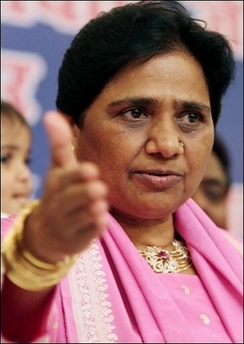
Bahujan Samaj Party leader and Uttar Pradesh Chief Minister Mayawati, along with the BSP candidates for the Delhi parliamentary constituencies at an election rally in New Delhi on Sunday.
New Delhi: BSP supremo Mayawati on Sunday targeted the Congress for being “anti-Dalit” and asked the people to teach the party a lesson.

“Baba Saheb Ambedkar had told Dalits not to vote for the Congress even after his death, after a Congress-fielded candidate defeated him in the 1952 Lok Sabha elections with the gross misuse of the government machinery,” Ms. Mayawati told an election rally here and asked the people to avenge the defeat of Dr. Ambedkar.

She alleged that the Congress led by “Nehru and Company” had attempted to block the entry of Dr. Ambedkar in the Samvidhan Sabha of the country through various measures. “These are the facts after knowing which, people from the Dalit community can never forgive the Congress,” she said.

In an apparent attack on AICC general secretary Rahul Gandhi, the BSP supremo criticised top Congress leaders visiting Dalit ‘bastis.’

“Few Congress leaders who are visiting Dalit bastis should understand that the problems of Dalits will not be solved by eating from their hands, sleeping in their houses or carrying Dalit children on their shoulders,” she said.

She alleged that the UPA government did not release Rs. 72,000 crore for Dalits’ welfare from the special component plan. “This exposes the Congress love for Dalits. The Congress hand embezzled this money.”
“You have to avenge this anti-Dalit mentality of the Congress by ensuring that its candidates lose their deposits,” she said, adding that the BJP and other parties also “have the same attitude” towards Dalits as they are also “offshoots” of the Congress.

“We do not treat the BJP and other parties differently from the Congress. All these parties are Chacha-Bhatija (uncle nephew) parties of the Congress. You have to ensure that these parties of Chacha-Bhatija, namely, BJP and other parties do not succeed,” the BSP leader said.

She attacked the Congress over the recent CBI clean chit to the Italian businessman Ottavio Quattrocchi and Congress leader Jagdish Tytler, whose role in the 1984 riots had come under controversy.

She accused the Congress of persecuting BSP leaders in Delhi and advised it to “desist from such acts as it’s now exit time for Congress.”

Ms. Mayawati came down heavily on the Opposition parties for spreading rumours about the BSP and trying to mislead the upper castes about her party’s ideology.

“Our party is not against any caste or religion. Our party is not caste or religion-specific. It’s a party of Sarvajan Hitaye, Sarvajana Sukhaye. We want to make a society based on equality,” she said.

She cited ticket given by the party to upper castes as well as the meteoric rise of the BSP general secretary Satish Chandra Mishra in the party to hammer home her point.

Ms. Mayawati said that if the BSP government came to power at the Centre, it would ensure reservation to the poor among upper castes, reservation for SC/ST and OBC in judiciary, legislative council, Rajya Sabha and such other places.

She said despite her numerous letters to the government at the Centre, the latter had not responded to her on these issues.

Attacking the UPA government for not implementing the recommendations of the Sachchar Committee for the welfare of Muslims, she said the BSP gave ticket to Muslim candidates in areas where they were in good numbers so that they could enter Parliament and Assembly.

On the contrary, the Congress gave only a few tickets to the minorities, she alleged.

Alleging that the BJP and the Congress made policies for the capitalists because they won elections with their money, she said, “these are the reasons why no change happened in the social and economic status of the Dalits and Sarvajan Samaj even 61 years after independence.”

She took a dig at the Congress’ flagship job scheme NREGA and said, “providing 100-day jobs to one family member will not end unemployment. Permanent employment is required to solve the problem.”

The BSP leader also said ill-treatment of people migrating to metros to eke out a living would not be tolerated if her government came to power and said her party would tackle the menace of naxalism and terrorism.
Read On

It is no longer just BSP vs SP in Uttar Pradesh

4:12 AM

BSP supremo Mayawati
Venkitesh Ramakrishnan


Lucknow: The electoral battle in Uttar Pradesh is steadily acquiring the dimensions of a quadrangular contest. This is the impression as the campaigning for the 18 seats in penultimate phase of polling in Uttar Pradesh came to a close on Tuesday and the electioneering for the fifth and final phase — scheduled for May 13 — gathered momentum in the remaining 14 seats.

What was originally considered to be an electoral tussle between the Bahujan Samaj Party (BSP), which controls the State government, and the principal Opposition, the Samajwadi Party (SP), is no longer confined to that dimension. The two national parties, the Congress and the Bharatiya Janata Party (BJP), have made their presence felt in a sizable number of constituencies. In the process, it has become clear that neither of the two regional forces is going to match the dominant SP performance — 39 out of 80 — of 2004.

Splintered Minority vote


SP chief Mulayam Singh Yadav
The factors that have contributed to this situation are manifold. These include the splintering of the Muslim vote in several political directions, the consequent advantage obtained by the Hindutva-oriented BJP, the appreciation that the social sector programmes of the Congress-led United Progressive Alliance (UPA) such as the National Rural Employment Guarantee Scheme (NREGS) has evoked among a number of communities particularly in rural Uttar Pradesh, and the virtual collapse of the Dalit-Brahmin brotherhood built by the BSP during the 2005 Assembly polls.
The splintering of the Muslim vote had become evident right from the first phase of polling on April 16, and that has continued apace in the later phases too. In 2004, the largest chunk of Muslim votes had gone to the SP. But the SP’s association with the former BJP Chief Minister, Mr Kalyan Singh, has divested the party of the favourite position among the minority voters. The SP is still preferred by the community in seats fought by its stalwarts, such as Mr Mulayam Singh Yadav and Mr Akhilesh Yadav, but elsewhere it is moving in other directions.
Cases in point among the seats going to polls in the last two phases are Moradabad and Dhaurahra, where former Indian cricket captain Mohammed Azharuddin and a former Union Minister, Mr Jitin Prasad, respectively are attracting large segments of Muslim voters as Congress candidates. In Rampur too, the opposition to the Kalyan Singh association by senior SP leader, Mr Azam Khan, is causing problems for Jayaprada, the party’s sitting MP from the seat.
Congress, BJP benefit The BJP had benefited from the split in the Muslim vote in earlier phases too. In the seats going to polls in the last two phases this advantage is palpable in Aonla and Meerut, among others. In Aonla, former Union Minister, Mrs Maneka Gandhi, is the BJP candidate. The collapse of the BSP’s Dalit-Brahmin brotherhood has led to the flight of Brahmin votes away from the party in constituencies such as Moradabad and Aligarh. In Moradabad, it is benefiting the Congress while in Aligarh the BJP is the beneficiary.
Amid the gains being made by the Congress and the BJP, the two principal parties of the State are holding on with the strength of their core vote base. The BSP’s Dalit vote base continues to prop up its candidates in seats such as Saharanpur, Bijnor and Nagina while the SP’s OBC (Other Backward Caste) vote base stands it in good stead in constituencies such as Mainpuri, Kannauj, Etawa and Firozabad. Still, there is little doubt that both the regional forces are far behind their expectations at the beginning of the poll process.
Read On

The grip of change

11:30 PM
Party: Bahujan Samaj Party
Constituency: Kanyakumari
State: Tamil Nadu
Mission statement: I want to be an instrument of change


P. Sivakami got a head start over the others. She completed the first round of her campaign in Kanyakumari, while other candidates were waiting for their parties to finalise alliances. A former IAS officer, she quit the service to join politics. And she chose Kanyakumari because of its high literacy rate (next only to Coimbatore) and the fact that it has the highest per capita income in the State.

“These two aspects make me believe that people in the constituency will go for a candidate like me,” says the 53-year-old Bahujan Samaj Party contestant. This explains why she chose this general constituency despite being a Dalit.
The author of four novels and a hundred short stories, she has published the English version of her Tamil novel, Pazhaiana Kazhithalum with the title “The grip of change.”
Ms. Sivakami rejects the argument that in this communally sensitive constituency — where Christians and Hindus are always waiting for an opportunity to settle political scores — she does not stand much chance.
“Tell me which constituency is not communally sensitive? The problem persists across the country. If it is not religion, it is caste. This should change. In the last 10 years, the world has changed a lot and you cannot afford to remain unchanged. In Kanyakumari, I want to be an instrument of change,” she stresses.
In contrast to the high-voltage campaign of the main political parties, hers is restrained. But even so, her name is familiar to all the households in the district. She meets leaders and office-bearers of various organisations and addresses street corner meetings.
She rejects the argument that she is an outsider in the constituency, saying her husband belongs to the district. “I have close contacts with many social organisations in the district. I am also aware of its problems,” she says.
Ms. Sivakami says she has no regrets about quitting the IAS to test political waters. “Many asked me why I quit the service when the pay commission recommendations were being implemented. They say I would have benefited heavily. But I know what I am doing.”
She says that as ex-IAS officer, she has had the advantage of working closely with politicians. “I have studied politicians and how they function. I am better equipped for the job,” she says.
Read On

Mayawati assures Sikhs of justice for 1984 riot victims

7:17 AM
Ludhiana, Apr 28: Bahujan Samaj Party supremo and Uttar Pradesh Chief Minister Mayawati today sought to assure the Sikhs that they would be given justice and those responsible for the anti-Sikh riots of 1984 would be brought to book.

''If we are voted to power at the Centre, stringent action will be taken against those responsible for the 1984 riots'', she said while addressing an impressive election rally at the grain market on NH=I here.

In an apparent attempt to woo the Sikh voters, Ms Mayawati said that her party had always favoured punishing those who were responsible for the riots. She decried the clean chit given by the CBI to Jagdish Tytler despite his indictment by the Nanawati Commission.

''The Congress has always used the CBI like a puppet to settle scores'' she alleged at her first poll rally in the border state.

''The Congress has been in the habit of handing out CBI threat to political opponents'', she said while reminding the people that she too had been hounded by the country's premier investigating agency.
Read On

Radio Pakistan comes to the aid of Dalits in India

6:49 AM
Abohar, April 28 : Instead of looking at its country’s depleting reputation in the world for being a haven for terrorists and the Taliban in Swat Valley, Radio Pakistan’s prime concern is the welfare of lower caste people in India.

In the latest Punjabi Durbar programme, Radio Pakistan has alleged that people belonging to the SC (Scheduled Caste) and ST (Scheduled Tribes) in India are subjected to inhuman treatment in India.

The programme has alleged that upper caste Brahmins don’t allow the lower castes to pray in temples or fetch water from their wells.

The allegations have been dismissed as baseless by Dr. Kuldeep Singh of Bahujan Samaj Party (BSP).


“Pakistan is trying to create divisions in the country by asserting that the concept of casteism overpowering India. As the district head of Bahujan Samaj Party I want to say that the system of casteism is the issue of the past. At present, in Bahujan Samaj Party people of different castes like Brahmins, Thakur, Kshatriya, Vaishya, Jatt Sikh to the people of lower castes like schedule castes and schedule tribes work together for the betterment and the progress of the country,” said Dr. Kuldeep Singh.

“I want to ask Pakistan about its system of casteism, where people are fighting one another. Such conditions will not be there in any other country of the world,” said Dr. Singh.

“At a time when India and Pakistan were united, the situation was very bad. Dr. Bhim Rao Ambedkar wrote our Constitution, which came into force on 26th January 1950. Since then the concept of casteism has been reduced to a great extent. He created a feeling of togetherness and brotherhood in the people of different castes and helped them in getting their rights.”

The broadcasters of Raido Pakistan need to study the Indian Constitution before airing baseless allegations about India. It must remember that that all Indians, irrespective of caste, creed, and religion have the Right to Equality.

In Uttar Pradesh, the people irrespective of their caste or creed or without any pressure of any community elected their leader Ms. Mayawati.

Moreover, people of the lower castes, today enjoy reservation in almost all government jobs and education institutes across the country.
Read On

Understanding Mayawati

9:58 AM
MAYAThe victory of the Bahujan Samaj Party in the 2007 Assembly elections in Uttar Pradesh and Mayawati’s subsequent statements that she hopes to become the next prime minister heading the Third Front, has attracted widespread attention.

Often dismissed as a mercurial and corrupt leader heading an opportunistic, power hungry party that joined hands with the “communal” Bharatiya Janata Party, there is intense curiosity today about Mayawati, her ideas, goals and programmes.

The BSP is the product of two post-independence forces: A long-term process of democratization which has questioned the privileged position historically occupied by the upper castes and classes; and state policies of affirmative action which offer the scheduled castes a more inclusive space in Indian society.

Consequently, the BSP was formed by a post-Independence, educated, politically conscious generation of middle and lower-middle class Dalits who actively oppose domination and expect a share in the fruits of post-Independence development. Mayawati epitomizes this generation.
Born into a lower-middle class family that took interest in the writings of Dr Ambedkar, she early imbibed an interest in the contemporary problems of the community, which brought her into politics. This generation believes - as Mayawati’s early speeches reveal -

Dr. Ambedkar was humiliated by Mahatma Gandhi during the Poona Pact of 1932 and more important, the nation-building project and Indian democracy which emerged was exclusionary and elitist, controlled by, and meant for, the upper castes.
Further, disillusioned with the Indian state and mainstream political parties for failure to provide protection to their life, property and dignity; they hold that capture of state power by a Dalit party is essential to create a more just society “from above”.
The BSP undoubtedly has a number of seminal achievements that have contributed to the social deepening of democracy: The creation of a new identity and counter-ideology of Dalit and Ambedkarism as an alternative to Harijan and Brahminism, respectively, has provided Dalits a new confidence and self-respect.

Consequently, the BSP was able to break down the vertical patron-client relationship with the upper castes, replace the Congress as the party representing the Dalits and consolidate Dalit vote in UP.
These developments have created a rising tide of aspirations among educated and politically aware Dalits in the country who look up to the BSP and support its endeavour for a pan-Indian presence.
Yet, it is questionable how empowering the BSP has been for the vast majority of subaltern Dalits. Both a party and a movement, its electoral success is due to the ability of Kanshi Ram and Mayawati to constantly re-invent the party and adopt strategies of electoral mobilization or alliances in response to the rapidly changing political scene in UP. In the late 1980s, a period of heightened polarisation due to Mandal and Masjid, the BSP was a radical social movement virulently hostile to the upper castes and parties representing them.
By the mid 1990s, realizing that it could not come to power alone, it shifted to an opportunistic political party that joined hands with the BJP to capture power. Once in power, Mayawati immediately put in place a slew of pro-Dalit policies that consolidated the Dalits behind her leaving the BJP leadership tremendously unhappy. With the decline of identity politics by the late 1990s, it has adopted the strategy of Sarvajan, attempting to gain the support of the upper castes in recent years.
Equally important, the BSP throughout the 1990s did not offer an economic vision or agenda for Dalit upliftment. The party came to power in 1995 based on a critique of the Congress described as anti-Dalit, but had little to offer as an alternative. It spent considerable amounts on ‘Dalit-oriented’ programmes like Ambedkar Villages, Periyar Melas, Ambedkar statues and memorials aimed at providing political empowerment, and consolidating the Dalit vote, but contributed little to their economic upliftment. These programmes emptied the treasury and put UP in a ‘debt trap’ with little funds left for investment in key sectors such as education, infrastructure and health, which was harmful for the economy, particularly the poorest sections, which include a substantial section of the Dalits.
The leadership failed to realise that sectional development was not possible in a situation of underdevelopment in the state.
However, some of Mayawati’s pronouncements and the economic agenda unveiled by her government after achieving a majority in 2007 provide room for some cautious optimism that now the focus will be on all-round development of the state and all sections of society.
The BSP’s goal of using its strategy of Sarvajan and its new economic policies is to create a broad-based umbrella party similar to the combine that enabled the Congress to rule UP in the past, the difference being that Dalits would occupy the commanding positions. Mayawati also hopes to replicate it in other states, build a pan-Indian identity and capture power at the centre.
Accordingly, in July 2007 the BSP announced that the “priority areas” of the government would be “rural development, agriculture, social development and infrastructure, all round development of all social segments not only Dalits and making the state conducive for attracting investment”.
Mayawati was able to persuade the Centre to provide substantial funds: A special economic package for all round development, a special area incentive package for developing the backward regions of Purvanchal and Bundelkhand and other developmental programmes. A target was set of 10 per cent growth rate and reduction of poverty by half during the 11th Plan period.
To win over industrialists and also help disadvantaged groups, Mayawati offered a voluntary scheme of “incentives” and “facilities” in the form of tax and other rebates to the former for setting up units in UP if they reserve 30 percent jobs in them for members of the SC, OBC, minorities and the “economically backward upper castes”. On completing six months in office, Mayawati claimed in November 2007 that her government had put into place a three-pronged agenda of improving law and order, a slew of inclusive developmental as well as pro-poor policies.
But BSP could face formidable political compulsions in implementing the new agenda as it has to balance the interests of all the social groups that voted it to power. The upper castes, who supported Mayawati expecting a share in political power and economic benefits, will not hesitate to return to the BJP if they feel neglected. The expectations of the Dalits will be that a BSP-headed government, moving beyond self-respect and political empowerment, should provide substantial material improvement and bring them into more prominent positions in society and polity.
Some of Mayawati’s actions on assuming office indicated attempts to reassure the upper caste and consolidate their support, best reflected in the composition of her cabinet. This expectedly brought a reaction from Dalits, leading to the announcement in June 2007 of the decision to demolish the Gomti Nagar Cricket Stadium in Lucknow to replace it with a memorial to Dalit leaders. It was widely viewed as an attempt to reassure Dalits as there were reports of discontent particularly among the youth, with her increasing emphasis on Brahmins on assuming power.
Some policies specifically for Dalits and other weaker sections were subsequently announced: Revival of Ambedkar-Village programme, housing and drinking water schemes for urban-based poor Dalits and attempts to ensure actual possession by Dalits of land allotted to them.
The success of the UP experiment - strengthening the Sarvajan base and implementing an inclusive developmental agenda - is of great importance for the BSP, evident from Mayawati’s efforts to explain these policies in her current electoral campaign across the country. But unless it works in UP, extending it elsewhere would be difficult. It is for this reason that the coming Lok Sabha election, the first after capturing power in 2007, is a testing time for Mayawati.
The National Democratic Alliance and United Progressive Alliance are in difficulties leaving space for alternatives: Both have lost important regional allies and are weak in UP; the former remains internally divided, while the latter is weak in big states such as Madhya Pradesh and Maharashtra and lacks a clearly designated leader. In this fragmented situation where small parties with a sizeable number of seats can play a central role, Mayawati hopes to emerge victorious leading the Third Front.
Even though this seems unlikely at present with the Front an inchoate medley of parties lacking organisational cohesion or common programme, the BSP could play a significant role in government formation, and its future trajectory in national politics will be keenly watched by political observers.
(Sudha Pai is professor at Centre for Political Studies at New Delhi’s Jawaharlal Nehru University. She is the author of Dalit Assertion and the Unfinished Democratic Revolution, the Bahujan Samaj Party in Uttar Pradesh.)
Read On

Mayawati says a ‘dalit’s daughter’ should be made next PM

12:41 AM
Bahujan Samaj Party Ramaipur, Apr 26 :  Bahujan Samaj Party (BSP) chief and Uttar Pradesh Chief Minister Mayawati on Saturday said a ‘dalit’s daughter’ should be made the Prime Minister of the country.

Mayawati further said a dalit Prime Minister would ensure the upliftment of the backward and minority communities in the country.

“If you make a dalit’s daughter the Prime Minister, then UP will be famous in the entire world. If the BSP comes to power at the Centre, UP will occupy a special place,” Mayawati said at an election rally here.

The UP Chief Minister also asked people to vote for her party to ensure state’s development.

“Unless the BSP government is in power both at the Centre and the state, the country and Uttar Pradesh will not progress,” she added.

Mayawati also criticized Prime Minister Dr. Manmohan Singh for criticizing her government’s track-record on development.

“The Prime Minister is not at fault. He will speak what the Congress leaders will tell him to say,” she added.

The BSP supremo further said the Congress party was nervous about the growing support base of her party.

“The Congress is very nervous about the growing support base of the Bahujan Samaj Party and therefore its leaders are resorting to giving misleading statements. It was the UPA government, which had rejected her demand for a 80,000-crore development package which forced her party to withdraw support to the alliance,” Mayawati added.
Read On

Decisive factor in several seats

2:37 AM
P. Sainath
Mumbai

Why this could be the make or break election for the Bahujan Samaj Party in Maharashtra

In 2004, the BSP polled over a million votes in the State without winning a seat

“This time around,” says a confident Suresh Sakhare, “the Bahujan Samaj Party will deliver a result in Maharashtra.” The party’s State vice-president points out that every political force must now take the “BSP factor” into account. “We are not spoilers,” Mr. Sakhare told The Hindu. “This time we will be winners. Please note that the prospect of Behenji as Prime Minister is rallying the poor and deprived to our flag everywhere.” Ms. Mayawati’s rally in Nagpur a few days ago was indeed impressive.
No party can take the BSP lightly, especially in the Vidarbha region. The party has also caused problems — right from candidate selection onwards — to the two main Fronts in places outside Vidarbha like Hingoli, Nashik and Pune. “The BSP is certainly a factor to reckon with,” says author and political analyst Dr. Anant Teltumbde. “This time they might just make that breakthrough.”
In the 2004 Lok Sabha poll, the Congress-NCP combine would have bagged 31 instead of the 23 seats in Maharashtra were it not for the BSP, which polled over a million votes State-wide without winning a seat. It secured around eight per cent of the vote in the State, over 11 per cent in Vidarbha. There were eight seats across the State where the BSP caused the rout of the Congress-NCP, polling far more votes than the margin of their defeat. The Congress lost in Erandol and Solapur and the NCP lost in Thane and Osmanabad precisely due to this. These seats are in the regions of Khandesh, Western Maharashtra, Mumbai-Konkan and Marathwada respectively.
Yet, it was in Vidarbha, where it polled over half a million votes, that the BSP hit the Congress-NCP worst. Here, it wrecked them in four seats — Bhandara, Wardha, Ramtek and Chandrapur. In 2009, it again threatens to hurt them in these very seats, in some of which it could increase its vote share. Also in others such as Ghadchiroli-Chimur where it hopes Raje Satyavan Rao will win the party its first Lok Sabha seat from Maharashtra. However, the effect of delimitation on its chances remains to be seen.The BSP is contesting all 48 seats in the state.
Two things have changed since 2004. The BSP is no longer a party for only Dalits. (Interestingly, in Bhandara, it has not made a major issue of the Khairlanji atrocity.) Nor is it just an alternative to the various factions of the Republican Party of India. The latter has been decimated. In this election, no one even speaks of the RPI. Meanwhile, the BSP is fielding candidates from several communities — including Brahmins, Muslims, OBCs and others. In Pune, the BSP’s D.S. Kulkarni, a Brahmin could hurt both BJP’s Anil Shirole and Suresh Kalmadi of the Congress. In Nashik too, its Brahmin candidate Mahant Sudhirdas Pujari, will cause problems for all others in the fray.
In the 2004 Assembly polls the BSP polled 8.6 lakh votes in Vidarbha, bettering its 5 lakh votes in the Lok Sabha elections just months earlier. It caused the defeat of the Congress-NCP in 13 seats and the BJP-Sena’s rout in 11. In effect, it decided the winner in over a third of the region’s 66 assembly seats. Only major electoral promises made by the Congress and an impressive campaign by Sonia Gandhi enabled the Congress-NCP combine to fare better than it did in the national elections.
Every third vote in Vidarbha is that of either a Dalit or an adivasi. “The Dalit vote here could be as high as 17 per cent while the adivasi vote could be around 15.6,” says Raju Mishra. He is the author of Janadesh, the definitive book on polls in the region. “However, the Dalit vote is far more focussed than that of the adivasi, which tends to be more divided. But all have to contend with this.” In the rest of Maharashtra, the Dalit vote has been differently, sometimes contradictorily, estimated at between 10-12 or 10-14 per cent. (There are different views on who is a ‘Dalit.’) The past few years have seen large chunks of that vote move away from the RPI to the BSP.
This could also be a make or break election for the BSP. The non-Congress/NCP, non-BJP/Sena vote has been rising in the State. Thus far, the BSP has been the gainer. Its ‘social engineering’ has seen it move beyond Dalit votes and candidates. This election could decide whether the party is relegated to the role of a perpetual spoiler. Or it could catapult it past the competitive threshold of Maharashtra electoral politics. If that happens, people will begin viewing it as a real alternative to the major Fronts and it would mark the start of a new phase in the State’s politics.
Read On

Maya fear spreads in Gujarat

2:40 AM
AHMEDABAD, Apr 7 : The elephant could run amok this Lok Sabha elections in Gujarat. Having witnessed a straight fight between Congress and BJP since 1995, the increasing might of Mayawati-led Bahujan Samaj Party (BSP) could play a spoilsport for the Congress party in the state. The rising influence of the party in rural Gujarat — evident from the rising vote share — could tilt the balance in favour of the BJP, feel political experts.

The BSP first entered the political fray in Gujarat by contesting on a single seat at Bulsar (Valsad) during the 1991 Lok Sabha elections. The party thereafter, rapidly expanded its presence in the state. In 2004, the BSP contested in 21 seats and this year, it is planning to put up candidates in all 26 Lok Sabha seats in Gujarat.

The vote share of the party that stood at just 0.57% in 1991, climbed to well-over 4% in constituencies like Rajkot and Chotta Udepur in the 2004 elections. Political pundits believe that 4% vote share of the BSP could make a difference between victory and defeat for the two large parties, the BJP and the Congress, which captured 47.37% and 43.86% respectively in 2004 elections. Among the 26 seats, BJP won 14 while the Congress cornered the remaining 12 seats.

Political expert and a serving professor at the political science department of Maharaja Sayajirao University (MSU) in Vadodara, PM Patel says, “Dalits constitute 7% of the state’s population (most of whom live in the rural areas). In the event of a close fight between the Congress and the BJP, the presence of the BSP could dent the Congress vote share in the rural areas, while it could dent the BJP vote share in the urban areas of the state. This is what happened in Uttar Pradesh”.

The professor however, adds: “Gujarat is more prosperous than Uttar Pradesh. The Dalits in urban Gujarat like the Parmars and the Vankars are among those who have benefited the most (both socially and economically) during the BJP-rule in the state. Hence the Dalits living in urban areas identify themselves with the BJP and it will be difficult for the BSP to get them into its fold. However, this is not the case in the rural areas where the caste factor is more prominent and Dalit groups like the chamars, rohit, valmikis, etc have remained poor”.

Experts feel that the vote share of the BSP could increase further in the upcoming elections as the Mayawati-led party is trying to expand its electoral voter base in Gujarat by incorporating the same social engineering that she had successfully experimented with in UP. “The BSP is not just targeting the Dalits in Gujarat, but all the socially and economically weaker sections of the society”, Mr Patel said.

“Though the BSP might gain vote share, it will be difficult for them to translate them into seats in a state where a two-party systemexists since 1995. However, the increasingly influence can affect the fortunes of larger parties”, Mr Patel added.

The professor’s views are endorsed by the results of 2004 general elections. For instance, on the Porbandar seat, the Congress candidate (45.55% votes) lost narrowly to his BJP rival who bagged 46.71% votes. On this seat, the BSP had got 1.49% votes. Similarly, on the Vadodara seat the losing Congress candidate bagged 47.44% votes, while the BJP won with a vote share of 48.45%. Here, the BSP had cornered a crucial 1.34% votes. Same was the case with seats like Dahod where the victory margin was a few hundred votes.

“We understand that the BSP’s presence is becoming stronger in Gujarat. In 2007 assembly elections, both the BJP and the Congress were surprised to see candidates coming forward to contest on BSP tickets. And this time, we are going to field our candidates for all the 26 constituencies in Gujarat”, BSP general secretary Nalin Bhatt told ET earlier.
This would be first time the party would be contesting on all the seats.

Earlier when late Kanshi Ram headed the BSP, the party had put up candidates in 14 states in 1996 general elections. However, the party scaled down its presence during the next general elections in 1999 by putting up just 4 candidates.
Read On

Six BSP legislators join Congress in Rajasthan

5:30 AM
JAIPUR - All six Bahujan Samaj Party (BSP) legislators in Rajasthan Saturday joined the Congress, giving the ruling party a majority in the state assembly.

‘We have joined the Congress to give a stable government in the state. We had sought votes against the misrule of the previous BJP (Bharatiya Janata Party) government. Under these circumstances it was our responsibility to provide a stable Congress government, so we decided to join the party,’ said Rajendra Singh Gudha, one of the BSP legislators.

The Congress tally in the assembly now stands at 102, above the half way mark of 100. The move has come as a major respite for the ruling party.

The party formed the government with the support of independent legislators but was facing problems since a junior minister, Golma Devi, resigned from the Ashok Gehlot ministry.

Golma, wife of BJP rebel leader Kirori Lal Meena, was elected as an independent from Mahuwa. Political analysts saw her move as a pressure tactic by Kirori Lal Meena to get more seats for his nominees in Lok Sabha elections.

The rebel BJP leader, considered one of the main factors leading to the downfall of Vasundhara Raje’s BJP government, was reportedly angry with the Congress over ticket distribution for the Lok Sabha polls.

He wanted his nominees to fight on seven of the 25 seats in Rajasthan while the Congress was ready to give him only one seat.

Rajasthan goes to polls on May 7.
Read On

Rajnath accuses BSP & Congress for misusing NSA

11:51 AM
Lashing out at his opponents Bahujan Samaj party and Congress for misusing of stringent National Security Act (NSA) against Varun Gandhi to gain political mileage, BJP president Rajnath Singh on Wednesday said his party supports the BJP candidate from Pilibhit “politically and legally”.

‘It is quite unfortunate what’s happening with Varun today.

He is victim of the dirty politics. The party condemns this joint act of BSP and Congress for resorting to NSA, and stands by Varun Gandhi politically and legally,’ said Rajnath Singh at a rally in Jaipur.

“The Congress and BSP have created an Emergency-like situation by exploiting the NSA. Varun Gandhi has no criminal record. Invoking NSA against him is unlawful,” the BJP president echoed, and added, “The BJP will not remain passive.”

On Tuesday night, Varun Gandhi was shifted to Etah jail owing to security reasons. He was earlier lodged in the district jail in Pilibhit.

The decision was taken after the Vishwa Hindu Parishad (VHP) and other organizations called the one-day shutdown in the entire Bareilly region Wednesday to protest Varun Gandhi’s detention under the NSA.

On Sunday Mayawati government had booked the young Gandhi, who is to début in politics as a BJP candidate from the Pilibhit Lok Sabha constituency, for making inflammatory speeches during a public meetings held at Kalganj (March 7) and Barkhera area (March 8) or Pilibhit district.

According to the NSA provision, an accused booked under this Act can be detained for up to a year without trial, beginning with an initial three-month detention. The accused must be conveyed the grounds for his detention within five days, and the case must come before an advisory board, headed by a retired or serving High Court judge, within three weeks.

The advisory board can either sustain or annul detention. In the former case, the government can detain him for up to a year and in the latter case accused would have to be released.
Read On

BSP legislator booked for violating poll conduct

2:44 AM
Lucknow, Mar 31 : A legislator of the ruling Bahujan Samaj Party (BSP) and his supporter in Uttar Pradesh have been booked for defying the model code of conduct, police said on Tuesday.

A case has been registered on Monday against legislator Asif Khan 'Babboo' and a former village head Shiv Ratan Mishra at the Pali police station in Hardoi district, 110 km from here, for displaying firearms at an unauthorised public meeting.

"The illegal public meeting was organised last week in Simiria village to solicit support for Ram Kumar Kureel, the BSP nominee for the Hardoi Lok Sabha seat," police inspector Akhilesh Singh said on telephone.

He said the public meeting was organised without prior permission of the district administration. "We will forward our report to the state election commission for further action against the two," he added.
Read On

BSP candidate held for killing of 10 policemen

8:08 AM
PATNA - The Bahujan Samaj Party’s (BJP) Lok Sabha candidate Arjun Ravidas was Wednesday arrested in connection with the killing of 10 policemen in Bihar’s Nawada district last month.

Ravidas, the BSP’s candidate in the Jamui Lok Sabha seat, was arrested when he reached the district administration office in Jamui, about 200 km from here, to collect posters and nomination forms, said an official.

Ravidas, who is contesting elections for the first time, was wanted for his involvement in the Maoist attack on a police team in Nawada, about 170 km from here, on Feb 9.

Three suspected Maoist rebels had been arrested in connection with the incident.

According to police, over 100 armed Maoists ambushed an 18-member police party in a village in Nawada district. Ten policemen were killed, including Rameshwar Ram, the officer in-charge of the Kauakaul police station who was invited to chair a function to honour Hindu saint Ravidas at Mahuliatand village.
Read On

BSP candidate held in the killing of 10 policemen

4:17 AM
Patna, March 25 Bahujan Samaj Party’s (BJP) Lok Sabha candidate Arjun Ravidas was Wednesday arrested in connection with the killing of 10 policemen in Bihar’s Nawada district last month.

Ravidas, the BSP’s candidate in the Jamui Lok Sabha seat, was arrested when he reached the district administration office to collect nomination forms, said an official.

Three suspected Maoist rebels had been arrested in connection with the incident on Feb 9.

According to police, over 100 armed Maoists ambushed an 18-member police party in Nawada. Ten policemen were killed in the attack during which the Maoists looted 11 guns.
Read On

Why India needs its regional parties

4:24 AM
It is interesting how the elite suspect, ridicule and demonise those who do not fall in the same special category. And how the concept of the 'other' is created, placed into a stereotype and then used to foment hatred. This is done the world over with the rich and the powerful being more influential than the poor and the marginalised. It is also done for individuals and political parties that fall outside the acceptance parameters of the elite and currently this prejudice is very much on display in India.

Bahujan Samaj Party leader Mayawati  is facing the brunt of elite intolerance with the English media -- print and electronic -- reflecting this in more ways than one. The regional leaders are just about tolerated, with the elite making no bones about its preference for a two-party system in India. The two parties of course can only be the Congress and the Bharatiya Janata Party  as both have sufficiently elite leaders (caste and class) to make the parties acceptable. Regional parties are egoistic, divisive, corrupt, autocratic according to India's urban and suave elite, while the BJP and the Congress clearly pass muster.

Mayawati is corrupt they say. And while it is difficult to prove whether she is or not, what about the corruption of those who are in power today and who were in power yesterday. It is true that she flaunts her wealth and those who are acceptable to the elite do not. But was not money made in major transactions by the top politicians in power, either directly or through their sons and daughters? The political grapevine is well aware of these people, with the amounts received in bribes, and the businesses run under benami names known.

But this is not spoken of as it involves those that the elite regard as their own, and pass over with a general "oh all politicians are corrupt." But there is no vilification of the individual, as there is of Mayawati (or for that matter was of Lalu Prasad Yadav ) with the BJP and the Congress being able to easily hide the money spinning "enterprises" of its top politicians from public view.

Mayawati is autocratic, they say. But is the Congress dynasty democratic? Is decision making in the Congress taken by the few or the majority? Is the will of a chief minister allowed to prevail over that of the Congress president? Is the Congress prime minister -- if he or she is not from the dynasty -- able to have the final say on any important decision? Is the party able to choose its leader, or does it have to accept dynastic rule? Can Congress legislature units elect their own chief minister, or do they have to follow the diktat from the Centre? Ask S M Krishna, Digvijay Singh, Ashok Gehlot and even Sheila Dixit -- if they are courageous enough to speak the truth the story will be quite different from the image that the party likes to project.

Mayawati is casteist, they say. But is that a crime? Particularly, if the caste is the poorest of the poor, the untouchables who have been discriminated against for centuries? If by being in power, she can ensure that the Dalits are more secure, (a police lathi has not beaten a Dalit to pulp since she came to power) employed and get respect and dignity is that a problem? And are not the BJP and the Congress casteist? They might not say so but their policies in governance and out of it, have ensured that their support base has dwindled (in the case of the Congress) or not expanded (as in the case of the BJP) to cover basically the upper castes in the states. In UP for instance, the BJP has made some inroads into the backwards but the bulk of its support -- and that is not saying much -- comes from a section of the Thakurs and the Brahmins. The Congress has lost the support of the Muslims and the Dalits, and can just about speak for the upper castes in a few pockets of the state. Is governance as these parties practiced it, not casteist?

Mayawati has been in power now twice, she has been in politics now for several years. Has she presided over violence in any part of UP? Like the BJP has, and the Congress has -- in Gujarat, in Delhi , in Mumbai , in Karnataka, in Punjab, in Assam, in Orissa, it is a long list. And here one is not talking just of the central governments, one is talking of the state governments of these parties when they were in power. Is the Christian feeling more secure today under the BJP coalition government in Orissa? Or is the Muslim living without fear in Andhra Pradesh under a Congress government?
This is not to say that Mayawati will be the best prime minister. Or even to say that she will be a good prime minister. This is to say that she will be as good a prime minister as BJP's L K Advani  or Congress party's Rahul Gandhi . And that if they have the right to lead this country, so does she. She does not speak English well, she does not wear a new sari every day, she does not have the finesse that makes the elite comfortable.

But she is a Dalit woman who has fought through the prejudice of caste, gender and class and has done so peacefully without the BJP's violence or support from a dynastic right to inheritance.

It is time for the elite to shed its prejudice and intolerance, and realise that India is best represented through the regional parties. And that if these did not exist, violent struggles would have broken out in different parts of the country as the deprived are learning to recognise their rights and are not willing to be shackled and silenced by a two party system that does not meet their aspirations and does not recognise them as equals. It is true that everything is not perfect, far from it, but at least the presence of regional parties has been able to open the valve of discontent and give people alternatives that are important and crucial to the strengthening of Indian democracy.

Seema Mustafa is editor, Covert magazine.
Read On

My Blog List


PolitiClone Comments

Recent Posts

PolitiClone

Blog Archive

Visitors