Strategic choice
 Meira Kumar with President Pratibha Patil and Prime Minister Manmohan Singh on their way to the joint session of Parliament, which the President addressed on June 4. THE unanimous election of Meira Kumar as the country’s first Dalit and woman Lok Sabha Speaker is widely evaluated as a signal emphasising the seriousness with which the ruling Congress and other sections of the country’s polity hold the idea of empowerment of underprivileged sections such as the Scheduled Castes (S.C.) and women. While this evaluation is indeed valid, Meira Kumar’s elevation does contain a more nuanced political message too. This is a message that Meira Kumar herself has time and again sought to express forcefully during her 25-year-old political career. It is that the politics of Dalit assertion and women’s empowerment should not give in to sectarian impulses but should develop as part of broader trends in mainstream polity. In many ways, this political line marks a continuation of the direction pursued by the legendary Jagjivan Ram, Meira Kumar’s late father, who was part of many governments in independent India, starting with the first Congress Ministry led by Jawaharlal Nehru. This line held sway over the country’s polity for nearly four decades even though many other proponents of the politics of Dalit assertion found this “too soft” and believed that it failed to establish firmly the rights of the underprivileged sections. Since the late 1980s, proponents of the latter view and representatives of Other Backward Classes (OBC)-oriented identity politics began to rise, pushing aside the “accommodative line” of the Congress, represented by Jagjivan Ram and Meira Kumar. Organisations such as the Mayawati-led Bahujan Samaj Party (BSP) and the Ram Vilas Paswan-led Lok Janshakthi Party (LJP) grew in strength during this period, and the Meira Kumar line of thinking failed to receive acceptance. Meira Kumar’s elevation to the position of Lok Sabha Speaker after the 2009 general elections is a pointer, in many ways, that the moderate stream in the politics of Dalit uplift is coming into the reckoning, at least among a sizable section of the electorate. The election results signified a rout for the LJP, while the BSP, which had contested the elections projecting party leader Mayawati as the potential first Dalit Prime Minister of the country, failed to live up to expectations. In order to buttress the “first Dalit Prime Minister” claim, Mayawati too had sought to push forward an assimilative political line, which placed Dalit-Brahmin bhaichara (brotherhood) at the centre of its political-electoral scheme. However, as the results proved, this positioning and the scheme under which it was advanced was not acceptable to large sections of the population, including Dalits. It was the assimilative and accommodative line of the Congress that found greater acceptance. By positioning Meira Kumar in the important constitutional position of Speaker, the Congress leadership has also signalled that it is interested in strengthening the “accommodative line” and making it a more decisive factor in Dalit assertive politics. Meira Kumar’s own statements on assumption of office are in keeping with this perception. She said that as the country’s first Dalit and woman Speaker she hoped to bring a new perspective to the functioning of the Lok Sabha, but added that her primary agenda as the presiding officer would not be guided by gender- or community-specific parameters. “The Lok Sabha is the House of the people. The issues of the people have to be addressed in their entirety here. My effort would be to facilitate such wholesome application to the issues of the people” (see interview). At the level of women’s empowerment, the leadership of the Congress and the United Progressive Alliance (UPA) government has already affirmed its commitment to one-third reservation for women in Parliament and State legislatures, but it is expecting certain roadblocks. The opposition to the Women’s Reservation Bill by OBC-oriented parties such as the Samajwadi Party, the Rashtriya Janata Dal and the Janata Dal (United) and the political games that the Bharatiya Janata Party may be tempted to play using the regional parties are the factors behind this sense of foreboding. Many observers feel that, with Meira Kumar’s elevation, the Congress-UPA leadership has at least the consolation that it has put a woman in an important constitutional position.  Jagjivan Ram, the legendary Dalit leader. He served as a Minister in several Congress governments and also as Deputy Prime Minister. Meira Kumar fits in, broadly, with an accommodative and assimilative political approach at the personal level too. The cosmopolitan traits in her are evident from the number of languages she knows. She is fluent in Hindi, English, Spanish, Bhojpuri and Sanskrit. Her educational qualifications include a degree in law and a postgraduate degree in English. Her success in civil service examinations led to her selection as an Indian Foreign Service (IFS) officer in 1973. Her tenure with the IFS lasted 12 years and included stints with the Indian missions in Madrid and London and the Ministry of External Affairs in New Delhi. Her hobbies range from reading and rereading Kalidasa in Sanskrit to rifle shooting. A five-time member of the Lok Sabha, she won her first election from Bijnore in Uttar Pradesh in 1985, defeating two stalwarts of Dalit politics, Mayawati and Ram Vilas Paswan. Later, elections were won from Delhi and Sasaram, the constituency in Bihar held by her father for eight consecutive terms. Meira Kumar’s selection as the Speaker also marked, in a sense, the full rehabilitation of the Jagjivan Ram family in the Congress. Though he was part of several Congress governments and had held important portfolios such as Defence, Communications, Labour and Railways, Jagjivan Ram fell out of favour with Prime Minister Indira Gandhi during the Emergency (1975-77). Jagjivan Ram had made bold to quit the Congress, after the announcement of general elections in February 1977, and was instrumental in ensuring the defeat of the Indira Gandhi regime. He became part of the first non-Congress Janata Party government which came up in 1977 under the leadership of Morarji Desai. The government collapsed in less than two years, and Jagjivan Ram’s efforts to rustle up support to become Prime Minister did not succeed. He was disillusioned with the turn of events and, towards the end of his life, made a return to the Congress. Rajiv Gandhi, who became Prime Minister following the death of Indira Gandhi, facilitated this return. It was at this time that Meira Kumar too joined politics and became a Lok Sabha member. Even so, the position accorded to Meira Kumar was not on a par with the position that Jagjivan Ram had as a Dalit leader in the Nehru dispensation. Meira Kumar was one among many Dalit Congress leaders, such as Sushil Kumar Shinde, Krishna Tirath and Kumari Selja. By any yardstick, Shinde was considered to be the frontrunner in this group. However, with the trends witnessed in the 2009 elections, the Congress leadership, particularly Sonia Gandhi, seems to have estimated that Meira Kumar is best suited to represent the party’s commitment to “accommodative and assimilative” Dalit-oriented politics. The Congress president could have of course chosen other politicians, such as Selja and Krishna Tirath, but by selecting Meira Kumar, Sonia Gandhi has signalled to the Jagjivan Ram family that it is back with full honours in the Congress scheme of things. Clearly, the larger messages that emanate from Meira Kumar’s appointment mark a historic shift in the country’s polity. It is a shift which indicates that the progressive streak in the country’s polity is indeed strong. However, it remains to be seen whether, and how far, the nuanced messages of Meira Kumar’s elevation – according importance to assimilative and accommodative Dalit-oriented politics as opposed to sectarian pursuit of Dalit assertive politics – live up to expectations. •
Send this article to Friends by E-Mail (Letters to the Editor should carry the full postal address) Home | The Hindu | Business Line | Sportstar | Publications | eBooks | Images Copyright © 2009, Frontline. Republication or redissemination of the contents of this screen are expressly prohibited without the written consent of Frontline | |
Meira confident she will be heard

That Kumar is confident of managing Lok Sabha and projecting herself as a symbol of women and dalit empowerment is good news for Congress which has authored the surprise move.
In a freewheeling interview with TOI, Kumar touches on issues ranging from scepticism of her soft voice to the caste factor.
Q: First, your soft voice and criticism that you cannot manage the House.
A: Women have soft voices. But it has never been a problem for me. I have been in electoral politics for 25 years, where we travel all over, to the interiors. I have campaigned for myself and for others in assembly and parliamentary polls. My voice has always been heard. If it can be heard in my constituency and get me a positive mandate, then why would it not be heard in Lok Sabha.
Q: Too much focus on your soft voice?
A: It's because there have only been men as Speakers. It's a man's reaction, but it's a woman's voice.
Q: You are hailed as a symbol of dalit empowerment.
A: Since I became Speaker, my house has been inundated by ordinary people from Tamil Nadu, Andhra, J&K, Punjab, West Bengal etc. They are ordinary people who have missed 3-4 days of work, lost wages, bought tickets to travel, just to greet me. I think they do feel empowered. I am not in a position to benefit them. But a message has gone out and it has had an impact. They are dalits, also people across caste lines, there are women. I thought it subside after two-three days but it has only gone on increasing.
Q: But in Parliament, you appeared to prefer identity of a woman against the popular focus on your caste.
A: Unfortunately, caste is a dominant factor in Indian society. As I say, ours is a `janmapradhan' and not `karmapradhan' society. All achievements -- character, learning, sacrifice -- are incomplete till your caste is revealed.
Q: That makes you uncomfortable as you appeared to have played down the caste factor in your acceptance speech?
A: No. I have always felt that certain sections need empowerment. They don't need patronage but social justice. We have to talk of them, regardless of who we are. It is myopic to think that only if you belong to a group can you talk of it. And because I am from that group, I cannot shy away from it.
Q: Congress chose to send a message to SCs and women by making Jagjivan Ram's daughter the Speaker. But since even the Opposition can lay claim on your father, has it diluted Congress authorship of the move?
A: But he has been on both sides, that was the trajectory of his long political career. He was in Congress and in Janata Party. He was a man of the masses. He was a kind of person whom everybody would remember. He cuts across party or caste lines.
Q: Your views on women's quota bill?
A: It has been on the table for many years. There have been hurdles. Efforts are on for a consensus. There is a new Parliament, a new atmosphere. I want the quota, I want women to be empowered. I have said what has started with my election should continue.
Q: You piloted the contentious bill on reservation in private sector as minister of social justice (MSJ)? Your thoughts on it in the wake of women's bill.
A: We achieved a lot in MSJ. It's about changing the mindset. There was vehement opposition to private sector quota but in one year, we convinced captains of industry that there was a problem which needed to be addressed. They agreed to it, though they held out against reservation. They also agreed that merit was related to circumstances (of birth). We succeeded in changing the mindset.
Q: How do you look back on your tenure as social justice minister?
A: It was very fulfilling. I got a platform to do what I was doing all my life -- working against atrocities, against discrimination and education for the deprived.
Q: How was your experience as Speaker in the first session?
A: The first session passed off peacefully. Members spoke without disruption. The beginning was good. The first session in last Parliament was very disturbed. So, it's a positive sign.
In the Chair, a new voice of consensus
 |
| Lok Sabha Speaker Meira Kumar at her first news conference. Picture by Rajesh Kumar |
New Delhi, June 4 : Meira Kumar can get angry, but she never cries.
India’s first woman Speaker, whose “reed-thin” voice might sound like a squeak compared to predecessor Somnath Chatterjee’s booming bellow, gave a hint of the steel beneath her mild demeanour as she took over the task of minding the House today.
Asked what she was like as a woman, the 64-year-old countered with a query.
“Are you asking personal questions?” she shot back.
“Like everybody else,” she added, “I get angry. But I don’t cry.”
Unruly members, take note.
On her first day, members were on their best behaviour, congratulating the first woman Speaker and promising to co-operate with her.
Nine-time CPM MP Basudeb Acharia, who stood up to offer the Left’s support to the Speaker, had difficulty shedding a habit of almost 30 years and kept addressing Meira as Sir till the backbenchers corrected him and he switched to Madam.
Meira, a former diplomat, spoke on a range of issues, like poverty, exploitation and generational change, but stressed on consensual politics as she promised to rise above ideological and partisan interests to uphold the spirit of the Constitution.
“The meaning of democracy lies in being compassionate and respectful towards those who don’t agree with you,” she said, quoting Nehru.
If that came as a balm for the poll-bruised Opposition, more salve followed. She cautioned the ruling side that good governance in a country like India was not possible without constructive co-operation of every member.
In her acceptance speech to the Lok Sabha and later at her first news conference as Speaker, Meira showed political correctness and humility. She recalled the legacy attached to the Speaker’s office — from G.V. Mavalankar, the first Lok Sabha Speaker, to Chatterjee — and said she felt humbled.
Meira, daughter of the late Dalit leader Jagjivan Ram, said the choice of a woman for the post was more than a symbolic gesture. She said the unanimous decision to elect a woman to run the House, two years after the election of India’s first woman President, showed the nation’s firm resolve to empower women.
“We have a long way to go but there is a genuine intention to make women’s position stronger,” she said. “Women’s empowerment is not merely a slogan but concrete steps are being taken in that direction.”
Even on women’s empowerment, her focus was on consensus. Though every leader who spoke in the Lok Sabha after her election felt that the jinxed women’s reservation bill could be headed for a better future, Meira explained the Constitution couldn’t be amended without consensus.
Asked if women MPs would now get proper time to speak, she dismissed the suggestion that members got more or less time because of their gender.
Meira dwelt on poverty and exploitation and said Independence meant little for a vast majority of Indians, especially Dalits and tribals, and quoted Gandhi to say it was pointless if members of Parliament were in disconnect with the masses.
Pointing out that around 300 new MPs were “young”, she asked the older MPs to guide them and to give priority to the aspirations of youth.
The new Speaker showed maturity by being non-committal on contentious issues like the no-work-no-pay, diminishing working hours in Parliament and salaries of MPs.
On criminals entering Parliament, she avoided any idealist posturing. “Everybody wanted to bar criminals from Parliament,” she said, “and the Election Commission was taking steps in that direction.”
Asked about her favourite colour, Meira said: “I like green. I am a green woman.”
Her favourite book, she said, was Kalidas’s Abhigyan Shankuntalam. “I read it again and again.”
First decision
Speaker Meira Kumar issued her first directive within an hour of taking charge by expunging exchanges between JD(U) chief Sharad Yadav and RJD president Lalu Prasad. The verbal duel started when Yadav objected to certain remarks made by Lalu Prasad while congratulating Meira.
Consensus on Meira for Speaker
NEW DELHI: The Lok Sabha is all set to get a Dalit woman as its Speaker. Ms Meira Kumar, who resigned from the Union Cabinet on Sunday, has become the consensus candidate of both the ruling coalition and the Opposition, including BJP.
The formal nomination of Ms Kumar for the post of Speaker of the Lok Sabha is expected to be announced on Tuesday. Congress president Sonia Gandhi, who is also UPA chairperson, is expected to propose Ms Kumar’s name in the nomination paper. It is likely to be seconded by Leader of the House Pranab Mukherjee. She’ll be formally elected as the Speaker on Wednesday.
The choice of Ms Kumar as the party's candidate for the presiding officer of the Lok Sabha is the crowning glory of the Congress' efforts to woo the Dalit vote.
In its second innings, the UPA has appointed nine Dalits in the council of ministers, of which five are in the Cabinet — four from Congress and one from DMK. Ms Krishna Tirath is the sole Dalit among the seven ministers of state with independent charge.
Congress, which is experiencing a revival, especially in politically crucial states like Uttar Pradesh, would like to tap into the Dalit votebank. In Uttar Pradesh, there has been a degree of disenchantment with Mayawati's BSP even among the Dalits.
Congress would not like to miss the opportunity to draw this sizeable votebank into its fold. In appointing Dalits from across the country to positions of responsibility and authority, Congress hopes to present an alternative and more inclusive focal point.
So, while Ms Mayawati's efforts of "social upliftment" have been centred on making a "dalit ki beti" (a Dalit's daughter) the prime minister, Congress is attempting to present a more inclusive picture of empowerment.
Congress' resurgence story was most clearly visible in Uttar Pradeh in the general elections. The party would like to consolidate onto this renewed interest of the electorate. Attracting the Dalit vote is crucial if the party has to place itself ahead of BSP. It has already managed to eat into BSP and SP's Muslim vote base, and cornering at least a section of the Dalit vote would place it ahead of its rivals in the state.
The formal nomination of Ms Kumar for the post of Speaker of the Lok Sabha is expected to be announced on Tuesday. Congress president Sonia Gandhi, who is also UPA chairperson, is expected to propose Ms Kumar’s name in the nomination paper. It is likely to be seconded by Leader of the House Pranab Mukherjee. She’ll be formally elected as the Speaker on Wednesday.
The choice of Ms Kumar as the party's candidate for the presiding officer of the Lok Sabha is the crowning glory of the Congress' efforts to woo the Dalit vote.
In its second innings, the UPA has appointed nine Dalits in the council of ministers, of which five are in the Cabinet — four from Congress and one from DMK. Ms Krishna Tirath is the sole Dalit among the seven ministers of state with independent charge.
Congress, which is experiencing a revival, especially in politically crucial states like Uttar Pradesh, would like to tap into the Dalit votebank. In Uttar Pradesh, there has been a degree of disenchantment with Mayawati's BSP even among the Dalits.
Congress would not like to miss the opportunity to draw this sizeable votebank into its fold. In appointing Dalits from across the country to positions of responsibility and authority, Congress hopes to present an alternative and more inclusive focal point.
So, while Ms Mayawati's efforts of "social upliftment" have been centred on making a "dalit ki beti" (a Dalit's daughter) the prime minister, Congress is attempting to present a more inclusive picture of empowerment.
Congress' resurgence story was most clearly visible in Uttar Pradeh in the general elections. The party would like to consolidate onto this renewed interest of the electorate. Attracting the Dalit vote is crucial if the party has to place itself ahead of BSP. It has already managed to eat into BSP and SP's Muslim vote base, and cornering at least a section of the Dalit vote would place it ahead of its rivals in the state.
Meira to boost Congress’ image of inclusivity Meira to boost Congress’ image of inclusivity
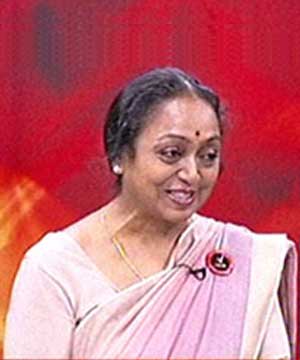 NEW DELHI: On Sunday, when Union minister for Water Resources Meira Kumar made her way to 10 Janpath, residence of Congress president Sonia Gandhi, it was clear that Ms Kumar has emerged as the top contender for Speaker’s post. Leaving Ms Girija Vyas and Mr V Kishore Chandra Deo far behind in the race.
In elevating the newly appointed water resources minister to Speaker, the glass ceiling will have been decidedly shattered. Though a Dalit Speaker is no novelty — the late GM Balayogi of TDP had presided over the House of Representatives — it will be the first time that a woman and Dalit will grace the Speaker’s chair. The move will further consolidate Congress’ claim as the party of inclusive growth. Ms Kumar’s elevation could well be the harbinger of an era of greater gender and caste parity.
Born in 1945, Ms Kumar is second of the two children of the Dalit leader from Bihar, Jagjivan Ram. The soft-spoken five time MP could well be said to have grown up in the corridors of power. Her father became the youngest minister in the Jawaharlal Nehru’s provisional government in 1946. From then on till 1978, Mr Ram served virtually uninterrupted in one capacity or another in successive governments. Parliament too was not a strange or far off concept for Ms Kumar, after all her father who was an influential Dalit leader, had been a member of Parliament right up until his death in 1986.
Ms Kumar’s career trajectory was far removed from the hurly burly of Indian politics. Her only brief foray in her early twenties was as the chairperson of the National Drought Relief Committee of the Congress during the 1967 drought. As the head of the committee she launched a Family Adoption Scheme — drought-affected families were adopted by affluent families.
As was the wont of most well educated youngsters of her time, Ms Kumar took the civil services route, making it to the Indian Foreign Service. As an officer of the 1973 batch, Ms Kumar served in Madrid and London.
It would appear that the pull of politics, which had been a constant in Meira Kumar’s life proved to be hard to resist. Her induction into formal politics came in 1985, barely a year before her father passed away. She became yet another successful professional, who had the added advantage of family involvement, to join politics after Rajiv Gandhi assumed the office of prime minister.
Her first venture electoral venture was in Bijnore in Uttar pradesh, from where she was elected to the eighth Lok Sabha. However, it proved to be beginner’s luck, Ms Kumar lost the next two elections. In 1996, she contested from the Karol Bagh parliamentary constituency in Delhi, which she won. Ms Kumar retained the seat in the twelfth Lok Sabha. Once again, in 1999 she was voted out. For her next electoral venture in 2004, Ms Kumar chose to return to Sasaram, a seat her father had held for nearly three decades. She won the elections and was made minister for social justice and empowerment.
NEW DELHI: On Sunday, when Union minister for Water Resources Meira Kumar made her way to 10 Janpath, residence of Congress president Sonia
Gandhi, it was clear that Ms Kumar has emerged as the top contender for Speaker’s post. Leaving Ms Girija Vyas and Mr V Kishore Chandra Deo far behind in the race.
In elevating the newly appointed water resources minister to Speaker, the glass ceiling will have been decidedly shattered. Though a Dalit Speaker is no novelty — the late GM Balayogi of TDP had presided over the House of Representatives — it will be the first time that a woman and Dalit will grace the Speaker’s chair. The move will further consolidate Congress’ claim as the party of inclusive growth. Ms Kumar’s elevation could well be the harbinger of an era of greater gender and caste parity.
Born in 1945, Ms Kumar is second of the two children of the Dalit leader from Bihar, Jagjivan Ram. The soft-spoken five time MP could well be said to have grown up in the corridors of power. Her father became the youngest minister in the Jawaharlal Nehru’s provisional government in 1946. From then on till 1978, Mr Ram served virtually uninterrupted in one capacity or another in successive governments. Parliament too was not a strange or far off concept for Ms Kumar, after all her father who was an influential Dalit leader, had been a member of Parliament right up until his death in 1986.
Ms Kumar’s career trajectory was far removed from the hurly burly of Indian politics. Her only brief foray in her early twenties was as the chairperson of the National Drought Relief Committee of the Congress during the 1967 drought. As the head of the committee she launched a Family Adoption Scheme — drought-affected families were adopted by affluent families.
As was the wont of most well educated youngsters of her time, Ms Kumar took the civil services route, making it to the Indian Foreign Service. As an officer of the 1973 batch, Ms Kumar served in Madrid and London.
It would appear that the pull of politics, which had been a constant in Meira Kumar’s life proved to be hard to resist. Her induction into formal politics came in 1985, barely a year before her father passed away. She became yet another successful professional, who had the added advantage of family involvement, to join politics after Rajiv Gandhi assumed the office of prime minister.
Her first venture electoral venture was in Bijnore in Uttar pradesh, from where she was elected to the eighth Lok Sabha. However, it proved to be beginner’s luck, Ms Kumar lost the next two elections. In 1996, she contested from the Karol Bagh parliamentary constituency in Delhi, which she won. Ms Kumar retained the seat in the twelfth Lok Sabha. Once again, in 1999 she was voted out. For her next electoral venture in 2004, Ms Kumar chose to return to Sasaram, a seat her father had held for nearly three decades. She won the elections and was made minister for social justice and empowerment.
Meira Kumar meets Sonia, ahead of formal declaration for LS Speaker post
NEW DELHI - Union Water Resource Minister and Congress leader Meira Kumar called on Congress party President Sonia Gandhi on Sunday afternoon.
The meet, which was held at 10, Janpath, Sonia Gandhi’s residence, gave strength to speculations about her getting a nomination of Congress Party for the post of Lok Sabha Speaker.
Reports in Sunday newspapers widely suggested the name of Congress leader Meira Kumar, who comes from Dalit community and better known as the daughter of former Deputy Prime Minister Babu Jagjivan Ram, waiting official ‘go ahead’ of the high command in the party.
Meira Kumar’s name is believed to have been cleared by the Congress core group on Saturday night.
Coming out of Sonia’s residence, the 64-year-old Kumar, refused to divulge any development to mediapersons. Aides close to Meira later informed that she would speak to journalists only after her name is officially announced as a candidate for the Speaker’s post.
Meanwhile, in the evening, Lok Sabha Secretary General P. D. T. Achary called on Kumar.
The meet, which was held at 10, Janpath, Sonia Gandhi’s residence, gave strength to speculations about her getting a nomination of Congress Party for the post of Lok Sabha Speaker.
Reports in Sunday newspapers widely suggested the name of Congress leader Meira Kumar, who comes from Dalit community and better known as the daughter of former Deputy Prime Minister Babu Jagjivan Ram, waiting official ‘go ahead’ of the high command in the party.
Meira Kumar’s name is believed to have been cleared by the Congress core group on Saturday night.
Coming out of Sonia’s residence, the 64-year-old Kumar, refused to divulge any development to mediapersons. Aides close to Meira later informed that she would speak to journalists only after her name is officially announced as a candidate for the Speaker’s post.
Meanwhile, in the evening, Lok Sabha Secretary General P. D. T. Achary called on Kumar.
