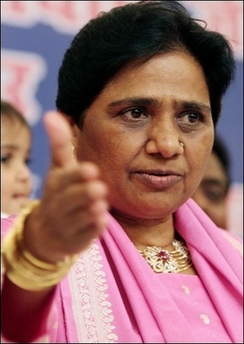
Her supporters hand-feed her cake, she covers herself in diamonds and has a fleet of planes. Yet, as a Dalit, an 'untouchable', she is loved by India's legions of poor and could even be prime minister after the general election
For a woman who has made a career out of her membership of the lowest rung of Indian society, the politician known only as Mayawati has some very expensive tastes. The "queen" of the Dalits - the acceptable name for what were once the untouchables - has a particular fondness for the Oberoi, one of Delhi's most luxurious hotels, where she regularly drops in for a spot of pampering in the beauty salon.
She celebrates her birthday with lavish public parties, decking herself in diamonds and allowing her acolytes to hand-feed her cake. She has a fleet of 12 planes and helicopters, including a Beechcraft jet she uses as her flying office, and an estimated annual income in excess of £7m.
Her life is a world away from the poverty in which most of India's 160m Dalits subsist. Yet far from begrudging her such luxuries, they appear to love her for it. They call her Behenji - sister - and pack into her rallies to listen to her speak.
And if the month-long Indian general election currently underway produces the expected stalemate between the Congress and Bharatiya Janata party, it is just possible that their votes will enable her to win enough seats to become the power broker and even, though this remains a slim possibility, allow her to demand a role she so desperately craves: that of prime minister of India.
What she would do with it is anyone's guess. As chief minister of Uttar Pradesh, India's most populous state, Mayawati is perhaps better known for spending millions on parks and statues celebrating her Bahujan Samaj party than for doing anything to change the lives of the people she governs.
More a pragmatist than an ideologue, she started in politics lambasting the upper castes, urging her supporters to hit them with their shoes, yet had no qualms about forming an alliance with the high caste Brahmins to secure her most recent electoral victory. She has not been slow to court other minorities, including Muslims and Sikhs.
But it is not her policies that make Mayawati fascinating: it is more the possibility that a Dalit, a caste associated with the most menial occupations, may finally get her hands on the top job. Forget untouchable - a few years ago, this would have been unthinkable.
In keeping with her superstar status, Mayawati uses just one name (her full name is Kumari Mayawati Das). She was born in Delhi in 1956, the daughter of a government clerk and a housewife, members of the low-caste Hindu Jatav community.
Her relationship with her father, Prabhu Das, was troubled and the young Mayawati looked more to grandfather Mangal Sen, who served with the British army, as a father figure. He had refused to remarry after the death of his wife when his son was six months old and insisted on bringing the child up alone. This appears to have struck a chord with Mayawati, who was angered by her father's wish to find a new wife when her mother bore him three daughters.
"My grandfather said that granddaughters were perfectly capable of continuing the family heritage. He said that if girls are given a good education they can be as capable if not better than sons," she wrote in her autobiography, which offers some intriguing insights into the character of a young woman who would later go on to challenge the political establishment.
"As a child, I used to go with my parents to visit my maternal grandparents who lived in Simrauli village in Uttar Pradesh," she wrote. "One day, I was walking with my parents and grandparents past the river when out came a wolf right in front of us. The adults tried to restrain me by saying that I must stay away from the wolf otherwise it would eat me up. But instead of being scared, I challenged the wolf and said I would eat it up instead. Much to the horror of my grandparents and my parents, I chased the wolf. "
The family were desperately poor, so much so that when her young brother fell ill with pneumonia shortly after he was born, she had to carry him through a forest to the hospital because they could not afford a taxi.
Those days are long gone. Now the name Mayawati is synonymous with wealth and extravagance. As well her cars, helicopters and planes, she has 70 properties . Her birthdays are astonishing affairs. In Lucknow, capital of UP, she has declared the date - 15 January - to be "self-respect day" and appears at her parties clad in pink and festooned with diamonds, often surrounded by lifesize cutouts of herself (she is 5ft tall). This year's cake, her favourite Black Forest gateau, apparently weighed 53kg to mark her 53rd year.
Birthdays are a time for presents and Mayawati is no exception: so efficient are her supporters at securing donations, especially from officials and politicians keen to win her patronage, that there's an annual tally of £7m, which is scattered around more than 50 bank accounts. The size of her earnings has resulted in a criminal investigations into her tax affairs, though this is hardly unusual for an Indian politician.
Obsessed with cleanliness, she favours minimalist furnishings in her homes and is equally fastidious about her appearance. She lost 15kg after becoming vegetarian. She also chopped off her long and oily plait in favour of a bob and is known to indulge in a peroxide wash when she visits the Oberoi salon.
The obsession with her appearance extends to her public portrayal. Last June, she ordered a statue of herself in Lucknow to be taken down because she deemed it not tall enough: at 12ft, it was 3ft shorter than other statues in the same area. A new one was erected at a cost of £500,000. Then there's the book she published on her achievements which contains the chapter "If People Call me a Super Chief Minister, What Can I Do?"
Mayawati's private life is intriguing. Unmarried, she lived for many years with Kanshi Ram, the BSP president and her mentor, until his death in 2006 at the age of 72. The relationship was the subject of much speculation, though Mayawati has always insisted he was more like an older brother or father figure. Kanshi Ram, in his last interview, revealed he had been attracted to her by her coarse manner.
"I liked the way she spat and gave galis [expletives] in her speeches," he said.
According to Mayawati's biographer, Ajoy Bose, Kanshi Ram turned up unannounced at her house one winter's night in 1977 while she was studying for her law exams to become a district magistrate, or collector. He had heard good things about her, he said.
"Your courage, dedication to the Dalit cause and many other sterling qualities have come to my notice. I can make you such a big leader one day that not one but a whole row of collectors will line up with files in front of you waiting for orders, " he told her. That was enough to start her on her political career.
In 1995, under Kanshi Ram's patronage, Mayawati became UP's youngest chief minister at the age of 39. The then prime minister, PV Narasimha Rao, described it as "a miracle of democracy", but that government lasted just four months. Two years later, Mayawati was back, this time in coalition with the BJP, though that administration lasted only two months longer than her first. In 2002, her alliance with the BJP secured victory once more, only for the government to fall after 18 months amid controversy over a plan to build a massive shopping mall near the Taj Mahal. Allegations of corruption relating to the project have dogged her, though she denies doing anything wrong. She bounced back in 2007, this time winning a solo majority.
At the last general election, Mayawati's BSP won just 19 seats. This time around, it is determined to do better. Her rallies are organised with military precision by her Bahujan Volunteer Force, whose members wear blue uniforms and make sure the crowd is primed for her arrival. A Swiss-made tent, with air conditioning, carpets, fresh fruit and flowers, is always available for meetings.
"Uttar Pradesh is taken, now it's Delhi's turn," she tells her supporters, though she is realistic enough to know that she cannot win on her own.
If the BSP can secure enough seats, though, she may just be able to demand the top job in return for her support in a coalition. The business community is alarmed at the prospect - "disastrous" and "catastrophic" were two of the words cited in one recent report - but no one really knows how a Mayawati premiership may turn out.
Political critics say the last thing modern India needs is a politician whose selling point is her caste. Yet even her critics say that she is a good administrator, albeit one with a tendency to micro-manage.
All that is certain is that she would embrace the opportunity with gusto. Mayawati is the polar opposite of the cerebral but grey incumbent, Manmohan Singh. Her track record suggests it could be a short and bumpy ride, but bland it would not be. Indian politics would be a livelier and more colourful place. With added diamonds.
The Mayawati lowdown
Born Kumari Mayawati Das in Delhi in 1956, the daughter of a government clerk and a housewife, members of the low-caste Hindu Jatav, or Chamar, community. She studied law, with ambitions to become a magistrate, and taught before entering politics.
Best of times Sweeping aside the opposition to secure an outright majority in the 2007 state elections in Uttar Pradesh. The victory, secured with the support of upper-caste Brahmins, took her rivals by surprise and put her in a position where she could realistically start to think about the premiership.
Worst of times The collapse of her prevous administration amid corruption allegations over the construction of a shopping complex close to the Taj Mahal.
What she says "We treat the sarva samaj - all castes - as equals."
What others say "The entire political paradigm of Mayawati is based on fear, revenge and corruption. Her corruption is legendary, as is evident from the monuments she has built from Lucknow to Delhi. She should stop dreaming of becoming PM. Instead, she should focus on discharging her responsibility of chief minister of Uppar Pradesh first."
Congress party spokesperson Manish Tewari.