For Pachpute’s remarks, Valvi tenders apology

Pachpute, giving a reply on why tribal girls trained for jobs as airhostesses did not get jobs, had said on Thursday that they failed as they were not fluent in English and did not meet the professional and physical requirements for the job.
Valvi, apologising for Pachpute’s remarks, said the scheme to train tribal girls for airhostess jobs was in line with such a scheme in Nagaland, Arunachal Pradesh, Meghalaya and Manipur.
“The government cannot be expected to give them jobs. The scheme was meant to give them training to help them qualify for jobs,” said Valvi.
He added that six of the 100 girls who were trained got jobs, four in Air Deccan, one in Jet Airways and one in Air India. The Indian Express had first reported about tribal girls not getting jobs after completing training. After airlines did not recruit tribal students who passed out of the Air Hostess Academy, Pune, the government scrapped the scheme.
BJP, 14 parties in trouble with EC on poll expenses
NEW DELHI: BJP and 14 other parties are itself trouble from the Election Commission for not furnishing details of expenditure incurred during the last Lok Sabha election.
On April 16, EC issued notices to these parties asking them to reply by April 29. So far, only 31 parties have filed their expenditure returns before the EC.
Apart from BJP, the list includes Rashtriya Janata Dal, JD(S), Forward Bloc, Arunachal Congress, J&K National Panthers Party, Jharkhand Mukti Morcha, Manipur People's Party, Mizo National Front, Pattali Makkal Katchi, Puducherry Munnetra Congress, Revolutionary Socialist Party, United Democratic Party, National People's Party and Zoram Nationalist Party.
EC has asked why action should not be taken against these parties under the provisions of Election Symbols (Reservation and Allotment) Order 1968. It said if no reply was received by April 29, it would be presumed that the parties had nothing to say in the matter and the EC would take appropriate action against them.
In its notice, EC cited the Supreme Court judgment of 1996 which held that the poll panel could require the political parties to submit, for its scrutiny, details of expenditure incurred by them in connection with the election of their candidates.
EC reminded the parties that details should have been filed within a period of 90 days after the completion of elections. Despite repeated reminders, the parties have not submitted the requisite statements till date, EC said.
Indian opposition stages mass protest over food prices
Demonstrators from states as far flung as Assam in the country's northeast arrived on buses and trains chartered by the main opposition Bharatiya Janata Party (BJP) to protest at annual food inflation running at over 17 percent.
BJP president Nitin Gadkari accused the left-of-centre Congress government, elected on a pro-poor platform, of betraying voters' trust. He then collapsed in the 41-degree-Celsius (106-degree-Fahrenheit) temperatures.
The BJP has seized on steep rises in the prices of staple foods as an issue to revitalise its moribund fortunes, especially among the poor, who have traditionally supported the Congress.
The main rally was near the Mughal-era Red Fort in the old part of the city. Thousands then marched to the city's centre, waving saffron-and-green BJP flags and causing traffic chaos.
"Vegetables, dal, sugar - they are all getting too expensive, this government must go," BJP general secretary Vijay Goyal told the crowd.
The leader of the opposition in the lower house of parliament, Sushma Swaraj led a walkout of BJP members to attend the protest, saying it was "intended to shake up and wake up the government from its slumber".
The protest came a day after the central bank hiked leading interest rates by a quarter point for a second month in a row to try to check overall inflation, which stands at 9.9 percent, a 17-month high, stoked by food prices.
The rally, which took place under the watchful gaze of police carrying bamboo sticks, was the latest in a series of food price protests following shortages after last year's monsoon, the weakest in nearly four decades.
Latest figures showed food inflation at 17.22 percent, with the rate running above 15 percent since November.
"It's very difficult for ordinary people - the price rises are hurting us," said Bhudhen Chandanath, a farmer who travelled by train from Assam, told AFP.
The opposition has blamed Prime Minister Manmohan Singh's government, now in its second term of office, for failing to keep a check on prices since it was returned to power in elections last year.
It charges food stocks are rotting due to poor storage and says there are massive mark-ups by middlemen on farmers' produce.
The price row comes as the government seeks to keep allies in line for a key budget vote and end a scandal involving the IPL cricket tournament, which led to the resignation of high-profile junior foreign minister Shashi Tharoor.
Indian opposition stages mass protest over food prices
Demonstrators from states as far flung as Assam in the country's northeast arrived on buses and trains chartered by the main opposition Bharatiya Janata Party (BJP) to protest at annual food inflation running at over 17 percent.
BJP president Nitin Gadkari accused the left-of-centre Congress government, elected on a pro-poor platform, of betraying voters' trust. He then collapsed in the 41-degree-Celsius (106-degree-Fahrenheit) temperatures.
The BJP has seized on steep rises in the prices of staple foods as an issue to revitalise its moribund fortunes, especially among the poor, who have traditionally supported the Congress.
The main rally was near the Mughal-era Red Fort in the old part of the city. Thousands then marched to the city's centre, waving saffron-and-green BJP flags and causing traffic chaos.
"Vegetables, dal, sugar - they are all getting too expensive, this government must go," BJP general secretary Vijay Goyal told the crowd.
The leader of the opposition in the lower house of parliament, Sushma Swaraj led a walkout of BJP members to attend the protest, saying it was "intended to shake up and wake up the government from its slumber".
The protest came a day after the central bank hiked leading interest rates by a quarter point for a second month in a row to try to check overall inflation, which stands at 9.9 percent, a 17-month high, stoked by food prices.
The rally, which took place under the watchful gaze of police carrying bamboo sticks, was the latest in a series of food price protests following shortages after last year's monsoon, the weakest in nearly four decades.
Latest figures showed food inflation at 17.22 percent, with the rate running above 15 percent since November.
"It's very difficult for ordinary people - the price rises are hurting us," said Bhudhen Chandanath, a farmer who travelled by train from Assam, told AFP.
The opposition has blamed Prime Minister Manmohan Singh's government, now in its second term of office, for failing to keep a check on prices since it was returned to power in elections last year.
It charges food stocks are rotting due to poor storage and says there are massive mark-ups by middlemen on farmers' produce.
The price row comes as the government seeks to keep allies in line for a key budget vote and end a scandal involving the IPL cricket tournament, which led to the resignation of high-profile junior foreign minister Shashi Tharoor.
Sangma elected CLP leader, to be sworn in as Meghalaya CM tomorrow
Twenty-five of the 28 Congress MLAs in the state were present at the CLP meeting here this evening where Sangma was chosen leader.
The meeting took place after Lapang, 76, submitted his resignation to governor RS Mooshahary.
Lapang drove straight to Raj Bhavan after arriving from New Delhi.
"I have stepped down gracefully and willingly," he said. "The majority is with Mukul Sangma. I respect the sentiments of the MLAs."
Lapang had taken charge in May last year after dislodging an NCP-led coalition government.
It was he who proposed the name of trusted aide Sangma, 43, at the CLP meeting. The proposal was seconded by senior MLAs RC Laloo and Rowel Lyngdoh.
Luisinho Faleiro, Congress secretary in charge of Meghalaya, and senior leader Oscar Fernandes, who arrived here as observers, attended the meeting.
The central observers expressed the hope that Sangma would be able to provide a stable government to Meghalaya.
Sangma, a practising physician, said the formation of the new government would be done in consultation with the Congress leadership.
He said he had received letters of support from the alliance partners of the Congress — the United Democratic Party, the HSPDP, and independents.
Earlier, 21 legislators had pledged unconditional support to Sangma, who will head the fourth government in two years in the state.
Lapang quit in the face of a revolt against his leadership by legislators demanding his ouster and berths in the ministry.
Meghalaya CM sends resignation to Sonia
"The party president has accepted the resignation," the leader told IANS on telephone from New Delhi. State Congress legislators will meet in Shillong on Monday to elect a new leader.
Meghalaya heads for fourth government in two years
 Shillong, April 19 Meghalaya appears to be heading for its fourth government in a little over two years, with senior Congress leader Mukul M. Sangma likely to take over the mantle from beleaguered Chief Minister D.D. Lapang.
Meghalaya has already witnessed three governments with Lapang as chief minister twice during the current term of the assembly, which began March 2008.
Sangma, the deputy chief minister in the 12-member cabinet, was “unanimously chosen” as Lapang’s successor by 21 of the 28 Congress legislators at a closed-door meeting Friday night.
The meeting held at Sangma’s private residence was attended by rebel Congress legislators who had earlier projected assembly Speaker Charles Pyngrope as Lapang’s replacement. They have now pledged “unconditional support” to Sangma.
The rebels have demanded Lapang’s removal on charges that the state has not made any progress under his leadership.
“All 21 legislators have unanimously chosen Sangma as Lapang’s successor. I am sure the rest (Lapang’s loyalists) too will join us,” Prestone Tynsong, a senior Congress minister, said.
“All have pledged their unconditional support to me and to ensure coherence and unity in the Congress Legislature Party,” Sangma told IANS when asked if he enjoys the majority of the Congress Legislature Party (CLP).
“I am happy that this stalemate would be sorted out soon with the intervention of the Congress leadership,” he said.
Sangma and Tynsong also met Governor R.S. Mooshahary and apprised him of the situation.
Thereafter, Sangma left for New Delhi Saturday along with 21 legislators to brief Congress president Sonia Gandhi on the development.
Asked if he no longer enjoyed a majority, Lapang, who is camping in New Delhi said: “No one is indispensable, but the Congress high command will have a final say on it (leadership issue).”
He, however, reiterated his stand that he would step down only if it was proved that he had lost the support of a majority of the legislators.
“Unity of the party is my first priority and therefore, if the party directs me to pave the way for my successor I will have to abide by it,” Lapang said.
Soon after assembly elections in 2008, Lapang was sworn as chief minister, his fourth stint, for just 10 days.
Thereafter, a Nationalist Congress Party (NCP) backed United Democratic Party (UDP)-led five-party coalition took office with UDP chief Donkupar Roy as the chief minister, but barely within a year the coalition was dismissed and the state was brought under president’s rule.
Lapang, however, engineered dissension within the NCP-UDP coalition and managed to reclaim his job with the help of three independent ministers of the Roy ministry.
In the 60-member legislature, the Congress has 28 legislators and has the support of 10 UDP members, five independents and one KHNAM legislator. The main opposition NCP has 15 legislators.
Meghalaya chief minister admits losing majority support
Lapang's statement came a night after Mukul M. Sangma, the chief minister's trusted aide, was unanimously chosen as his successor by 21 of the 28 Congress legislators.
Sangma is currently a deputy chief minister in the Congress-led Meghalaya United Alliance (MUA) coalition government.
CPI-M for more autonomous bodies
“If constitutional autonomous bodies were formed for both tribals and non-tribals in backward areas across India, it would defuse the demand for separation or secession and develop those underdeveloped areas,” said CPI-M central committee member Bijon Dhar at a press conference in Agartala.
“Once the constitutional autonomous bodies formed, local people would be involved in the developmental process and they (locals) would administer themselves. Therefore, the centre and concerned state would allocate more funds for these local self-governments.”
The CPI-M also demanded more autonomy to the existing 16 autonomous district councils (ADC) in northeast India facilitating the socio-economic development of tribals, who constitute 27 percent of the region’s 40 million people.
Of the 16 ADCs, six are in Manipur, three each in Assam, Meghalaya and Mizoram and one in Tripura.
“If necessary, the constitution should be amended to establish fresh autonomous bodies and to provide more autonomy to the existing ADCs,” said Dhar, also the secretary of the Tripura state committee of CPI-M.
Dhar said: “Tripura is a model in the entire country where democratic decentralisation process among the tribals were exceptional in India. This was evident from the compliments from the Planning Commission, central ministers and senior officials.”
He said ministers, senior leaders and officials from the Congress and non-Left party-led state governments had visited Tripura in different times to learn from the Left Front government how to effectively run autonomous district councils for the tribal people.
Governance matters
Maoists thrive on the Government’s inability to provide meaningful governance. To fight Red terror, the political class needs to concentrate on ground level delivery and forge a consensus that Left extremism poses a serious threat to the nation. Anything less will not suffice
To get down to the brass tacks, perhaps political grandstanding was necessary. But shouldering responsibility a la “the buck stops at my desk,” is not sufficient.
There has to be a process of building a consensus on what is the Maoist problem. Between all the talking heads — Union Home Minister P Chidambaram, West Bengal Chief Minister Buddhadeb Bhattacharjee, Chhattisgarh Chief Minister Raman Singh, Odisha Chief Minister Naveen Patnaik, Jharkhand Chief Minister Shibu Soren, Bihar Chief Minister Nitish Kumar and even Andhra Pradesh Chief Minister K Rosaiah running around the mulberry bush is all that is happening with sporadic attempts to launch hunts that are inefficient in rooting out the problem.
The Maoists have the capability of planning an ambush and successfully pulling it off in Sildah, Dantewada, Odisha and earlier in Andhra Pradesh, Jharkhand, Bihar and even Maharashtra. This is not romantic guerrilla tactics. It is good military tactics. While the political class waffles on about how to tackle the Maoists the tactical advantage remains with them. Finding the consensus, naming the problem and quitting the blame-game will be the first sign of a political will to establish the rule of law in India. If the Centre believes that a third of the States are Maoist-infested surely what is at stake is the rule of law itself.
The terms on which the consensus needs to be reached is not the vague articulation of the issues involved, but a specific mapping of the problem. The deliberate regression or digression into the root causes of the Maoist problem is effectively one way of avoiding facing the problem, allowing every one of the talking heads to appear to be good and benign souls, rather than effectively govern.
In other words, a consensus needs to be arrived at is what exactly do all these people think on how the Maoists are the most serious internal security threat to India. Are the Maoists a simple law and order problem? Or are they more complicated and bigger than what any single unit of the Indian federal structure can effectively handle? Are the Maoists articulating the seething discontent of the tribals? Are the Maoists articulating the ghastly failure of delivery of governance to the poorest in the most backward parts of the country? How can an estimated 15,000-strong militia take on the combined forces available to the State Governments and the Centre? Why is the combined security operation ineffective?
By the logic of what the Maoists state and therefore the description of this force as the most serious threat to internal security, the problem is not a straightforward ‘law and order’ problem. Contrary to what Mr Bhattacharjee claimed it to be on Friday, the Maoists are not disrupting the usual law and order situation in West Bengal. In the pockets where they operate and thankfully they do so in limited parts of West Bengal, the Maoists are not disturbing the law and order norms. They are, by their own admission, waging war and doing so by means that are beyond the limited training and capabilities of the state’s police backed by the strength and training of the Central Reserve Police Force.
Mr Bhattacharjee must acknowledge as indeed must his peers that usually law and order requires to be maintained rather than established. In the present situation, which is unusual, what is now necessary to oust the Maoists and restore the first fallen brick of the larger edifice that goes by the generalisation ‘normalcy’. So too must Mr Chidambaram, who is the country’s Home Minister, is in overall charge of ensuring that every citizen can live with a sense of security and without fear.
Downgrading the problem to mere ‘law and order’ is to encourage the Maoists and those who cannot identify them as such, which tragically for West Bengal includes the leading Opposition party and its leader the Trinamool Congress and Ms Mamata Banerjee. By taking back the self-confessed Maoist sympathiser Kabir Suman, allowing him to retain his seat in the Lok Sabha, the message that has been delivered is that the Maoists have a refuge, if not within the Trinamool Congress, but certainly with political freelancers who are part of the party.
It is perfectly in order for Mr Chidambaram to ask the Communist Party of India(Marxist) and the Communist Party of India to clarify their political position vis-à-vis taking tough action against the Maoists. By that same logic, he needs to ask the Trinamool Congress and all other political parties in the Opposition-ruled States, including the Congress in Chhattisgarh, Odisha, why they should not clarify their activities in those States vis-à-vis the Maoists.
By clubbing ‘development’, that is the blueprint of development that has been adopted by every parliamentary political party in general even though there are specific issues of criticism, with concern for ‘tribal’ welfare and conservation and with law and order, what is revealed is the unwillingness of the political system to get tough. These are excuses for inaction and inefficiency.
Yes, it is true that there is an appalling and shameful absence of minimum utilities and services in the backward/tribal areas. Women have to walk miles to get water that is not strictly potable. It is equally true that the conservationist lobby that is protective of ‘tribal lifestyle and culture’ has barely considered these women to be the same as all other women in India. The tribal woman in order to protect a culture is required to fetch water, go into the forests to collect fire wood and eke out a hard, harsh, humiliating existence.
Yes, it is true that mining interests are involved in the equations that apply in the backward areas where the Maoists operate. It is true that there is a mining mafia in the country. It is equally true that the mining mafia has a political nexus.
These are old stories that are being recycled by cynics for their own reasons. The tribals in Bihar, Chhattisgarh, West Bengal, Odisha, Jharkhand and Andhra Pradesh have been subjected the ‘civilising’ agenda for well over a century, despite their rebellions and uprisings. The missionaries civilised them and now the Maoists are doing so, after the Indian state, which includes mining companies, power utilities, other businesses, did its bit. Ex-Maoist leader also a tribal, Gurucharan Kisku summed it all up; he reportedly said: “I quit the party when I realised that it does nothing for Adivasis.” The credibility of his complaint is established by his explanation: “The party is destroying this tribal system and way of life… It is following the proletariat line where distinctness is not recognised.”
Kisku can demand restoration or conservation of the tribal system and way of life. But he has to acknowledge that the way of life is not what it was in its pristine form, whenever that may have been. Kisku knows, as should the political establishment, that these are not islands as in the Andamans. Contamination is the reality and the Maoists are not the best cleaning agent that can effectively do the job.
The political class needs to arrive at a consensus from which a political will ought to emerge to deal with the threat to the way of life it promises to its citizens. Flawed as that model is pampering the Maoists as the protector of tribal culture and life is not the answer. The Maoist threat is, if indeed it is recognised as, a serious one and not only to law and order. It goes beyond that. The Maoists enjoy the advantage of operating on the perpetuation of failure of governance. The Maoists seem to hold the moral high ground because the political class prefers to make deals, score points rather than get down to brass tacks.
Rahul vs Mayawati over Ambedkar Jayanti in UP
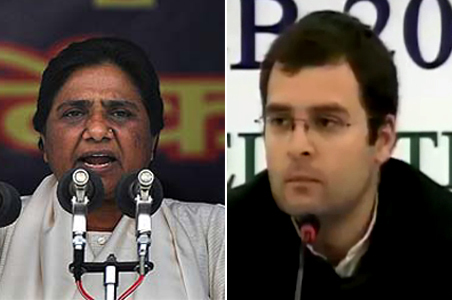
On Wednesday, these will roll out, flagged off by Congress leader Rahul Gandhi, to make inroads into what has been Mayawati's turf.
On the birth anniversary of Dalit leader BR Ambedkar, Gandhi and his party will flag off 10 state-wife yatras. The birthday celebrations are a politically correct excuse to launch the campaign for the state elections, now just two years away.
The UP Chief Minister, fiery at the best of times, is cranking up the rhetoric.
Ambedkar Nagar is her home constituency. And Ambedkar's statue lies in the area demarcated by her for the Bahujan Samajwadi Party's felicitations.
Barely 400 metres from the spot where Gandhi will send his teams out in their raths, is where Mayawati is hosting protests against the Women's Reservation Bill - pushed through the Rajya Sabha at the insistence of Sonia Gandhi. The bill sets aside 33 per cent of seats in parliament and state assemblies for women. Mayawati rejects it because it does not have a quota for Dalit women.
But her image as that of a champion of Dalits has tarnished a little among her voters, and the Congress is grabbing that as its main offense. In 2007, in the state elections, it was a combination of Dalits and Brahmins that swept Mayawati into power. In the general elections last year, the incongruous alliance was tiring. Fifty-six per cent of the state's Dalits did not vote, unhappy because they believed Brahmins were enjoying new power in a party that was meant to promote the interests of the castes and classes that had traditionally been overlooked.
An unnerved Mayawati has responded by indicating that 42 Brahmin representatives of her party in the state assembly will not be given tickets in the next state election. But the Congress everyday presents a carefully-calibrated narrative: of a self-assertive politician who abused the power Dalits gave her for jewels, garlands worth lakhs, monuments built for crores.
The Congress' calculation is that the Brahmins, now being shunned by the BSP, combined with the Dalits who're disappointed by Mayawati may lend themselves to a new vote.
What nobody's counting out, however, is Mayawati's determination and her ability to present herself as a woman of the masses, even when that link is not at its strongest.
Gadkari blows election bugle
| Party takes up battle to install BJP CM in Dispur | ||
| UMANAND JAISWAL | ||
Guwahati, April 5: The BJP today used the protest rally over price rise to launch the party’s campaign for the 2011 Assembly elections in Assam, with its national president Nitin Gadkari motivating the party’s rank and file to ensure the “installation” of a BJP chief minister at Dispur. Making his much-awaited political debut in the Northeast at a well-attended public rally at Sonaram High School ground here this afternoon, Gadkari made it clear that Assam figured prominently in the party’s scheme of things. Therefore, the party needed to stick together and go to every village to win the battle for Dispur. He was quick to add — without referring to the AGP with which it has a tie-up in the state though —that despite hoping to see a BJP chief minister at Dispur, the BJP was open to alliances with like-minded parties. All the four MPs the BJP has in the Northeast are from Assam, while of the nine MLAs it has in the region, six belong to the state. Had the four MLAs who voted for the Congress candidate during the March 26 Rajya Sabha elections in Assam not been suspended, the total number of BJP MLAs in the Northeast would have stood at 13. “We will replace them with four new candidates,” Ranjit Dutta, state party president, said. “It will be Assam in 2011 and Delhi in 2014. We should work together and take everybody along with us to ensure our objective of ousting the anti-people Congress,” Gadkari said in his hourlong speech, attended by party members from all the seven states of the Northeast. Gadkari took constant digs at chief minister Tarun Gogoi, Prime Minister Manmohan Singh and Congress president Sonia Gandhi, besides reminding the gathering of Jawaharlal Nehru’s “anti-Assam” policy during the 1962 Chinese aggression. Using a cricketing analogy to describe the impact of price rise, he said, “I was watching a cricket match recently when someone described Sachin Tendulkar as the best. I pointed out that tel and daal had hit a century while sugar has crossed 50. I think our PM is the best one-day player.” He asked his party members not to be worried “because four MLAs have left us. Such people have no value in our party. “Those who want to go, go,” he said. “The party is for honest and sincere people. The MLAs, MPs can become ex-MLAs or ex-MPs but one thing is constant: a worker does not become an ex-worker.” Gadkari also reached out to the minorities, saying the party was not against any religion, while dwelling on the issue of unabated influx into the region. “Those who love the motherland, irrespective of whether he goes to a temple or masjid is an Indian. Nusli Wadia, Jinnah’s great grandson, is a good friend of mine. I don’t understand why, despite the rush of illegal migrants into the Northeast, nothing is being done about the influx. This is because of vote bank politics. But we will continue to fight against it and are prepared for any qurbani that we are called upon to make,” Gadkari said. |

Brahmins bag most top BJP posts

The BJP's choice of presidents in electorally crucial states as well as its central list of office-bearers symbolically highlights the trend quite clearly.
The central unit led by Nitin Gadkari is dominated by the Brahmins.
Besides the two leaders of Opposition, Sushma Swaraj and Arun Jaitley, the senior-most general secretary, Ananth Kumar, is also a Brahmin.
Gadkari has dropped the sole OBC general secretary Vinay Katiyar.
He now holds an ornamental position as a party vice-president.
But in Maharashtra, Gadkari has tried to check the domination of Brahmins by appointing Sudhir Mungantivar as the state chief. Mungantivar, from Vidarbha, is a powerful OBC leader belonging to the Komti caste.
However, the party is led by Brahmins in most other states. Pandit Ashwini Sharma heads it in Punjab, while Arun Chaturvedi is the president of the Rajasthan unit. In Himachal Pradesh, the BJP has found a Brahmin, Pandit Khimi Ram, to head it.
There are indications that in states such as Uttar Pradesh, Madhya Pradesh and Bihar, the BJP will end up appointing a Brahmin. RSS-appointee Prabhat Jha seems to be the chosen one to head Madhya Pradesh. This signal was clear when Jha, accorded a Rajya Sabha berth last year owing to his proximity with the RSS strongman Suresh Soni, did not get any significant position in the central list of officebearers.
"It is a clear sign that Jha is going to MP," a party insider said.
Similarly in Bihar, three prominent names doing the rounds for the president's post are state general secretary Mangal Pandey, minister in the Nitish Kumar government Ashwini Choubey and senior leader Sukhda Pandey.
This is because the consensus in the state is that a Brahmin should be appointed to counter- balance Nitish's overt stress on wooing the "extreme backwards". Both Nitish and deputy chief minister Sushil Modi are OBCs.
Even in Uttar Pradesh, the BJP is desperate to fill the lacuna created by Atal Bihari Vajpayee's withdrawal from public life. Chief Minister Mayawati's social engineering is widely believed to be crumbling with the Brahmins drifting away because of Mayawati's ostentatious display of power and the creation of various parks and monuments in her name.
The BJP's biggest worry is that the Congress may turn out to be the beneficiary of the Brahmins' disenchantment with the BSP. While the BJP is considering many candidates, Lucknow mayor Dinesh Sharma is believed to be a strong contender because of his Brahmin lineage.
