

Calcutta, May 18 : Murmurs of dissent against Prakash Karat’s line are growing within the CPM.
Party's performance not satisfactory in Assam LS polls: BJP
Guwahati , May 31 : BJP today admitted that the party&aposs performance in the recent Lok Sabha polls in Assam was not satisfactory and they would hold a series of meetings to analyse the reasons behind this.
BJP&aposs Central observer for Assam Harendra Pratap told reporters here that though the party had improved its tally from two to four in the state but the overall results were not"up to our satisfaction".
The party will hold a series of brainstorming sessions in the state to analyse the performance of the candidates and also chalk out future strategy, he said.
The BJP had won the Gauhati, Mangaldoi, Nagaon and Silchar constituencies in the just-concluded general polls. Congress emerged as the winner with seven seats.
BJP&aposs Central observer for Assam Harendra Pratap told reporters here that though the party had improved its tally from two to four in the state but the overall results were not"up to our satisfaction".
The party will hold a series of brainstorming sessions in the state to analyse the performance of the candidates and also chalk out future strategy, he said.
The BJP had won the Gauhati, Mangaldoi, Nagaon and Silchar constituencies in the just-concluded general polls. Congress emerged as the winner with seven seats.
Team Manmohan gets to work

The 78-member three-tier ministry, which Manmohan Singh described as a mix of energy and experience, has been asked to set benchmarks. United Progressive Alliance (UPA) chairperson Sonia Gandhi stressed that everyone would be judged by their performance.
Vayalar Ravi, who retains charge of the overseas Indian affairs ministry, got to business straight away, saying his immediate task was to protect the Indians in Australia after a spate of allegedly racial attacks this week.
He said the government was seriously considering “an institutionalised mechanism” to prevent racist attacks on Indians abroad.
“The government has taken the matter seriously. My immediate task is to ensure the safety of Indians there. I have asked for a report from the Indian High Commission in Australia,” said Ravi.
Murli Deora, who retains the petroleum and natural gas ministry, announced a new scheme for distribution of liquefied petroleum gas (LPG) in villages.
Kamal Nath, who now heads the ministry of road transport and highways, said regulations covering India’s road network will be overhauled and promised to change the physical landscape of the country’s transport infrastructure.
“We need to look at the old regulatory framework in an entirely new way and that will call for a complete change of mindset. We are looking at new models,” Kamal Nath said.
DMK leader T.R. Baalu’s leadership of the ministry earlier had come under widespread criticism.
“Policies cannot be measured - there can be a number of policies,” said Kamal Nath, the former commerce and industry minister. “But roads and highways can be physically measured. This is a major infrastructure area. Results will be seen… I have been given a challenging task.”
Commerce and Industry Minister Anand Sharma, promoted to the cabinet, said India will maintain its exports at $160 billion for the current fiscal and unveil steps in the coming budget to help the sector.
“This is a challenging responsibility and I will benefit from my earlier experience. Economic diplomacy is part of global engagement,” said Sharma, formerly a minister of state in the external affairs ministry.
Sharma said India was ready to sign a host of agreements including a free trade pact with the Association of Southeast Asian Nations (ASEAN) and economic cooperation pacts with South Korea and Nepal.
The minister said the country’s export performance was laudable given that the global economy had shrunk since last year. “I am confident we will be able to manage at least $160 billion.”
Kapil Sibal, the cabinet minister in charge of human resource development
, told reporters: “I want to put in place a system where every child and person can have access to resources and education.”
Former UN diplomat and writer Shashi Tharoor, appointed the minister of state in the ministry of external affairs, said he would work to strengthen India’s global stature.
“India’s place in the world is of great importance. India has had an honoured place in the world. I wish to make my own contribution to strengthening that very honoured place.”
Preneet Kaur, also a minister of state in the same ministry, said India wanted peace with neighbours but it would never tolerate terrorism.
“We always want good relations with neighbours but the one thing we will not tolerate is terrorism and sheltering of terrorists,” she asserted.
Health Minister Ghulam Nabi Azad said India would focus on developing new vaccines to fight new diseases.
National Conference patron Farooq Abdullah, who heads the new and renewable energy ministry, said his biggest challenge was to tap “new energy”.
Updated List of Cabinet ministers of india 2009
Prime Minister Manmohan Singh named the new ministers to serve in the country’s next 5 YEARS.
List of New ministers of india 2009:
Kamal Nath Union Road Transport and Highways Minister Madhya Pradesh INC
Salman Khursheed MoS Independent Charge (Minority Affairs and Corporate Affairs) Uttar Pradesh INC
Pranab Mukherjee Union Finance Minister West Bengal INC
P Chidambaram Union Home Minister Tamil Nadu INC
Sachin Pilot MoS (Communications and IT) Rajasthan INC
Kumari Selja Union Tourism Minister, MoS (Housing and Urban Poverty Alleviation) Haryana INC
Harish Rawat MoS (Labour and Employment) Uttarakhand INC
Ajay Maken MoS (Home Affairs) NC Territory of Delhi INC
K H Muniyappa MoS (Railways) Karnataka INC
Subodh Kant Sahay MoS (Food Processing Industries) Jharkhand INC
Jyotiraditya Madhavrao Scindia MoS (Commerce and Industry) Madhya Pradesh INC
Sharad Pawar Union Agriculture, Food and Civil Supplies Minister Maharashtra NCP
Daggubati Purandeswari MoS (Human Resource Development) Andhra Pradesh INC
M M Pallamraju MoS (Defence) Andhra Pradesh INC
Panabaka Lakshmi MoS (Textiles) Andhra Pradesh INC
Pawan Kumar Bansal Union Parliamentary Affairs Minister Chandigarh INC
M K Azhagiri Union Chemicals and Fertilizers Minister Tamil Nadu DMK
Dayanidhi Maran Union Textiles Minister Tamil Nadu DMK
Sushil Kumar Shinde Union Power Minister Maharashtra INC
M.Veerappa Moily Union Law and Justice Minister Karnataka INC
Jaipal Reddy Sudini Union Urban Development Minister Andhra Pradesh INC
S M Krishna Union External Affairs Minister Karnataka INC
A K Antony Union Defence Minister Kerala INC
Anand Sharma Union Commerce Minister Himachal Pradesh INC
G K Vasan Union Shipping Minister Tamil Nadu INC
Murli Deora Union Petroleum and Natural Gas Minister Maharashtra INC
Prithviraj Chavan MoS Independent Charge (Science and Technology and Earth Sciences) Maharashtra INC
Mukul Wasnik Union Social Justice and Empowerment Minister Maharashtra INC
Mallikarjun Kharge Union Labour and Employment Minister Karnataka INC
Kantilal Bhuria Union Tribal Affairs Minister Madhya Pradesh INC
Dinesh Trivedi MoS (Health and Family Welfare) West Bengal AITC
Praful Patel MoS Independent Charge (Civil Aviation Minister) Maharashtra NCP
Virbhadra Singh Union Steel Minister Himachal Pradesh INC
Preneet Kaur MoS (External Affairs) Punjab INC
Mamata Banerjee Union Railways Minister West Bengal AITC
Ghulam Nabi Azad Union Health and Family Welfare Minister Jammu and Kashmir INC
Vayalar Ravi Union Overseas Indian Affairs Minister Kerala INC
Meira Kumar Union Water Resources Minister Bihar INC
Kapil Sibal Union HRD Minister NC Territory of Delhi INC
Ambika Soni Union Information and Broadcasting Minister Punjab INC
B K Handique Union for Mines and Development of North Eastern Region Minister Assam INC
C P Joshi Union Rural Development and Panchayati Raj Minister Rajasthan INC
Dr Farooq Abdullah Union New and Renewable Energy Jammu and Kashmir NC
Sriprakash Jaiswal MoS Independent Charge (Coal and Statistics and Programme Implementation) Uttar Pradesh INC
Jairam Ramesh MoS Independent Charge (Environment and Forest) Andhra Pradesh INC
Namo Narain Meena MoS (Finance) Rajasthan INC
Vilasrao Deshmukh Union Heavy Industries and Public Enterprises Maharashtra INC
M Ramchandran MoS (Home Affairs) Kerala INC
Dr M S Gill MoS Independent Charge (Youth Affairs and Sports) Punjab INC
Dinsha Patel MoS Independent Charge (Micro, Small and Medium Enterprises) Gujarat INC
Krishna Tirath MoS Independent Charge (Women and Child Development) NC Territory of Delhi INC
E Ahamed MoS (Railways) Kerala MUL
V Narayanasamy MoS (Planning and Parliamentary Affairs) Puducherry INC
Srikant Jena MoS (Chemicals and Fertilisers) Orissa INC
Jitin Prasad MoS (Petroleum and Natural Gas) Uttar Pradesh INC
A Sai Prathap MoS (Steel) Andhra Pradesh INC
Gurudas Kamat MoS (Communications and IT) Maharashtra INC
Mahadev Khandela MoS (Road Transport and Highways) Rajasthan INC
Professor K V Thomas MoS (Agriculture and Consumer Affairs, Food & Public Distribution) Kerala INC
Saugata Ray MoS (Urban Development) West Bengal AITC
Sisir Adhikari MoS (Rural Development) West Bengal AITC
Sultan Ahmed MoS (Tourism) West Bengal AITC
Mukul Roy MoS (Shipping) West Bengal AITC
Mohan Jatua MoS (Information and Broadcasting) West Bengal AITC
S S Palanimanickam MoS (Finance) Tamil Nadu DMK
D Napoleon MoS (Social Justice and Empowerment) Tamil Nadu DMK
Dr. S Jagathrakshakan MoS (Information and Broadcasting) Tamil Nadu DMK
S Gandhiselvan MoS (Health and Family Welfare) Tamil Nadu DMK
A Raja Union IT and Telecom Minister Tamil Nadu DMK
Bharatsinh Solanki MoS (Power) Gujarat INC
Tusharbhai Chaudhary MoS (Tribal Affairs) Gujarat INC
Prateek Prakashbapu Patil MoS (Heavy Industries and Public Enterprises) Maharashtra INC
Pradeep Jain Mos (Rural Development) Uttar Pradesh INC
Arun Yadav MoS (Youth Affairs and Sports) Madhya Pradesh INC
R P N Singh MoS (Road Transport and Highways) Uttar Pradesh INC
Shashi Tharoor MoS (External Affairs) Kerala INC
Vincent Pala MoS (Water Resources) Meghalaya INC
Agatha Sangma MoS (Rural Development) Meghalaya NCP
List of New ministers of india 2009:
Kamal Nath Union Road Transport and Highways Minister Madhya Pradesh INC
Salman Khursheed MoS Independent Charge (Minority Affairs and Corporate Affairs) Uttar Pradesh INC
Pranab Mukherjee Union Finance Minister West Bengal INC
P Chidambaram Union Home Minister Tamil Nadu INC
Sachin Pilot MoS (Communications and IT) Rajasthan INC
Kumari Selja Union Tourism Minister, MoS (Housing and Urban Poverty Alleviation) Haryana INC
Harish Rawat MoS (Labour and Employment) Uttarakhand INC
Ajay Maken MoS (Home Affairs) NC Territory of Delhi INC
K H Muniyappa MoS (Railways) Karnataka INC
Subodh Kant Sahay MoS (Food Processing Industries) Jharkhand INC
Jyotiraditya Madhavrao Scindia MoS (Commerce and Industry) Madhya Pradesh INC
Sharad Pawar Union Agriculture, Food and Civil Supplies Minister Maharashtra NCP
Daggubati Purandeswari MoS (Human Resource Development) Andhra Pradesh INC
M M Pallamraju MoS (Defence) Andhra Pradesh INC
Panabaka Lakshmi MoS (Textiles) Andhra Pradesh INC
Pawan Kumar Bansal Union Parliamentary Affairs Minister Chandigarh INC
M K Azhagiri Union Chemicals and Fertilizers Minister Tamil Nadu DMK
Dayanidhi Maran Union Textiles Minister Tamil Nadu DMK
Sushil Kumar Shinde Union Power Minister Maharashtra INC
M.Veerappa Moily Union Law and Justice Minister Karnataka INC
Jaipal Reddy Sudini Union Urban Development Minister Andhra Pradesh INC
S M Krishna Union External Affairs Minister Karnataka INC
A K Antony Union Defence Minister Kerala INC
Anand Sharma Union Commerce Minister Himachal Pradesh INC
G K Vasan Union Shipping Minister Tamil Nadu INC
Murli Deora Union Petroleum and Natural Gas Minister Maharashtra INC
Prithviraj Chavan MoS Independent Charge (Science and Technology and Earth Sciences) Maharashtra INC
Mukul Wasnik Union Social Justice and Empowerment Minister Maharashtra INC
Mallikarjun Kharge Union Labour and Employment Minister Karnataka INC
Kantilal Bhuria Union Tribal Affairs Minister Madhya Pradesh INC
Dinesh Trivedi MoS (Health and Family Welfare) West Bengal AITC
Praful Patel MoS Independent Charge (Civil Aviation Minister) Maharashtra NCP
Virbhadra Singh Union Steel Minister Himachal Pradesh INC
Preneet Kaur MoS (External Affairs) Punjab INC
Mamata Banerjee Union Railways Minister West Bengal AITC
Ghulam Nabi Azad Union Health and Family Welfare Minister Jammu and Kashmir INC
Vayalar Ravi Union Overseas Indian Affairs Minister Kerala INC
Meira Kumar Union Water Resources Minister Bihar INC
Kapil Sibal Union HRD Minister NC Territory of Delhi INC
Ambika Soni Union Information and Broadcasting Minister Punjab INC
B K Handique Union for Mines and Development of North Eastern Region Minister Assam INC
C P Joshi Union Rural Development and Panchayati Raj Minister Rajasthan INC
Dr Farooq Abdullah Union New and Renewable Energy Jammu and Kashmir NC
Sriprakash Jaiswal MoS Independent Charge (Coal and Statistics and Programme Implementation) Uttar Pradesh INC
Jairam Ramesh MoS Independent Charge (Environment and Forest) Andhra Pradesh INC
Namo Narain Meena MoS (Finance) Rajasthan INC
Vilasrao Deshmukh Union Heavy Industries and Public Enterprises Maharashtra INC
M Ramchandran MoS (Home Affairs) Kerala INC
Dr M S Gill MoS Independent Charge (Youth Affairs and Sports) Punjab INC
Dinsha Patel MoS Independent Charge (Micro, Small and Medium Enterprises) Gujarat INC
Krishna Tirath MoS Independent Charge (Women and Child Development) NC Territory of Delhi INC
E Ahamed MoS (Railways) Kerala MUL
V Narayanasamy MoS (Planning and Parliamentary Affairs) Puducherry INC
Srikant Jena MoS (Chemicals and Fertilisers) Orissa INC
Jitin Prasad MoS (Petroleum and Natural Gas) Uttar Pradesh INC
A Sai Prathap MoS (Steel) Andhra Pradesh INC
Gurudas Kamat MoS (Communications and IT) Maharashtra INC
Mahadev Khandela MoS (Road Transport and Highways) Rajasthan INC
Professor K V Thomas MoS (Agriculture and Consumer Affairs, Food & Public Distribution) Kerala INC
Saugata Ray MoS (Urban Development) West Bengal AITC
Sisir Adhikari MoS (Rural Development) West Bengal AITC
Sultan Ahmed MoS (Tourism) West Bengal AITC
Mukul Roy MoS (Shipping) West Bengal AITC
Mohan Jatua MoS (Information and Broadcasting) West Bengal AITC
S S Palanimanickam MoS (Finance) Tamil Nadu DMK
D Napoleon MoS (Social Justice and Empowerment) Tamil Nadu DMK
Dr. S Jagathrakshakan MoS (Information and Broadcasting) Tamil Nadu DMK
S Gandhiselvan MoS (Health and Family Welfare) Tamil Nadu DMK
A Raja Union IT and Telecom Minister Tamil Nadu DMK
Bharatsinh Solanki MoS (Power) Gujarat INC
Tusharbhai Chaudhary MoS (Tribal Affairs) Gujarat INC
Prateek Prakashbapu Patil MoS (Heavy Industries and Public Enterprises) Maharashtra INC
Pradeep Jain Mos (Rural Development) Uttar Pradesh INC
Arun Yadav MoS (Youth Affairs and Sports) Madhya Pradesh INC
R P N Singh MoS (Road Transport and Highways) Uttar Pradesh INC
Shashi Tharoor MoS (External Affairs) Kerala INC
Vincent Pala MoS (Water Resources) Meghalaya INC
Agatha Sangma MoS (Rural Development) Meghalaya NCP
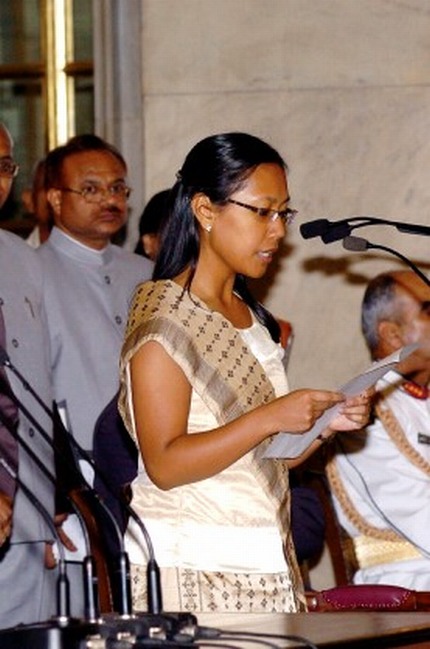
Agatha Sangma Youngest MP from Meghalaya
 UPA ministry expanded
New Delhi, May 29 : The Union Council of Ministers was today expanded with the induction of 59 ministers including three former chief ministers Vilasrao Deshmukh, Farooq Abdullah and Virbhadra Singh at the Cabinet level.
In all, 14 cabinet ministers, including DMK nominees M K Alagiri, Dayanidhi Maran and A Raja, and Congress' Mallikarjun Kharge were sworn in by President Pratibha Patil, six days after Prime Minister and 19 others took oath in the first instalment.
|
Seven Ministers of State with Independent Charge, including Praful Patel of NCP, Prithviraj Chavan, Salman Khursheed and Jairam Ramesh and 38 Ministers of State were also sworn in at a ceremony in the Rashtrapati Bhawan attended among others by Vice President Hamid Ansari, Prime Minister Manmohan Singh and Congress President Sonia Gandhi.
With today's induction, the strength of the Union Council of Ministers goes up to 79, including the Prime Minister, the same as the previous UPA government after the exit of Shivraj Patil.
M S Gill, Selja, Subodhkant Sahay, G K Vasan, Pawan Kumar Bansal, Kantilal Bhuria were the other cabinet ministers inducted today, all from Congress who have been elevated from the status of Ministers of State.
Mukul Wasnik, an MoS in the P V Narasimha Rao government, has been brought in as a Cabinet Minister.
Four Christians as ministers reflects Indian diversity: community
New Delhi, May 29 : India’s Catholic Christians are happy over increased representation of the community in the new government, with four of them being inducted into the union council of ministers.
A.K. Antony is defence minister while K.V. Thomas, Agatha Sangma and Vincent Pala are ministers of state. The previous United Progressive Alliance (UPA) government had three Christian ministers.“It shows the cultural and religious diversity of India, which has been the hallmark of our history and tradition,” said Rev Babu Joseph, spokesman, Catholic Bishop’s Conference of India (CBCI).
“All four of them are Catholics,” he said.
However, Antony, former Kerala chief minister and a Rajya Sabha MP, is a known atheist and declined to take oath of office in the name of god during the swearing-in ceremony of the Manmohan Singh cabinet last week.
Catholic Christians make up 1.8 percent of the country’s population, while the total Christian population is 2.5 percent.
While Antony and Thomas are from Kerala, Sangma and Pala belong to the northeastern state of Meghalaya.
Nationalist Congress Party (NCP) leader P.A. Sangma’s daughter Agatha, 28, is the youngest minister in the council of ministers. She represents Tura constituency in Meghalaya. Congress leader Vincent Pala, 41, is a first-time MP. He represents Shillong constituency. K.V. Thomas, 63, is a former Kerala minister. Thomas won the Lok Sabha elections from Ernakulam constituency.
The CBCI also said the inclusion of more Christian ministers in the council of ministers was a move towards an inclusive approach in the Indian polity.
Antony, Oscar Fernandez and P.R. Kyndia were the three Christians in the previous government.
However, the representation of Muslims in the new council of ministers has come down from six in the previous government to five - two of whom are cabinet ministers and three are ministers of state. Muslims constitute 14 percent of India’s population.
Mukherjee lays out economic plan; row with DMK settled
 New Delhi: Finance minister Pranab Mukherjee on Sunday set out the blueprint for the government’s economic policies in a meeting held at his residence with top ministry officials even as the ruling Congress party resolved a three-day row over cabinet berths with its key ally, the Dravida Munnetra Kazhagam, or DMK.
 At the meeting, attended by chief economic adviser Arvind Virmani and finance secretary Ashok Chawla, it was decided that Mukherjee, in consultation with Prime Minister Manmohan Singh, would prepare an approach paper on how to tackle the current economic slowdown and set the direction for economic policies.
According to a person familiar with the development who didn’t want to be identified, the key issues that are to be addressed in the paper will be “employment, growth, exports, manufacturing sectors and infrastructure”.
“The new government’s 100-day action plan and the next Union budget will be on the basis of this paper,” the official added.
Meanwhile, after three days of intense negotiations, the DMK on Sunday agreed to the Congress party’s offer of three cabinet berths in the United Progressive Alliance, or UPA, government, at least two Congress leaders said.
DMK chief and Tamil Nadu chief minister M. Karunanidhi’s elder son M.K. Azhagiri and grand-nephew Dayanidhi Maran, and close family associate A. Raja are expected to be inducted as cabinet ministers, the Congress politicians said. But senior DMK leader and former Union minister T.R. Baalu will not be part of the cabinet, they said.
The Prime Minister is expected to expand his cabinet in the next few days.
The two Congress leaders, who didn’t want to be identified, said the DMK will not be given any “infrastructure” ministries such as road transport and highways.
There was no official announcement from either the Congress or the DMK. According to a person close to the talks with the DMK, Karunanidhi is still in discussions with Baalu, who is apparently upset with the decision. Baalu didn’t respond to phone calls seeking comment.

Strategy maker:Pranab Mukherjee, in consultation with the Prime Minister, will prepare an approach paper on how to tackle the current economic slowdown as well as set the direction for economic policies. Subhav Shukla / PTI
Singh was forced to take the oath along with a mini cabinet of 19 members, including just two from Congress allies—Nationalist Congress Party (NCP) chief Sharad Pawar and Trinamool Congress leader Mamata Banerjee.
The portfolios of six ministers were announced on Saturday.
The DMK’s decision ended the stalemate between the ruling party and its second largest ally, clearing the way for a cabinet expansion expected on Tuesday.
The two Congress leaders said the DMK will also get four posts in the council of ministers.
The DMK, a crucial pre-poll Congress ally which has 18 members in the Lok Sabha, may get ministries such as information technology and chemicals and fertilizers.
Banerjee’s Trinamool Congress, which won 19 seats in the Lok Sabha, is expected to get six ministers of state included in the council of ministers.
The Congress leaders also said the Prime Minister may include some 50 more members in his ministerial council. Among Congress members, Jyotiraditya Scindia and Jitin Prasada (both were ministers in the previous government) and Sachin Pilot, who are members of the Congress party’s younger generation, are expected to be inducted.
Smaller allies such as the Indian Union Muslim League (IUML) and the National Conference (NC) will also find a place in the ministry.
Another Congress leader, who was a minister in the previous government, said the ruling party is keen to have its own speaker after a gap of 11 years. Although the DMK staked its claim for the post, the Congress may choose its five-term member V. Kishore Chandra Deo from Andhra Pradesh’s Parvathipuram, a constituency reserved for scheduled tribes.
Election to the speaker’s post will take place on 3 June, two days after the 15th Lok Sabha meets. President Pratibha Patil will address a joint session of the Lok Sabha and the Rajya Sabha on 4 June, in which she will outline the policies and agenda for the new government.
The first session, which will have seven sittings, will be followed by the budget session in early July. The budget is to be presented in the backdrop of the economic slowdown after five years of record economic growth of 8.8%.
The slowdown has begun to hurt government revenue collection. Growth in tax revenue during the five years of record economic growth was largely responsible for giving the previous UPA government resources to fund its social sector programmes, including the National Rural Employment Guarantee Scheme. The next budget would have to find ways to enhance government’s revenue as the Congress’ election manifesto had promised to increase the scope of social sector programmes.
Sanjiv Shankaran contributed to this story.
Why Mayawati loves to hate former aide P L Punia

Punia, who was elected from Barabanki constituency on a Congress ticket, was her principal secretary in her three previous regimes in 1995, 1997 and 2002.
Mayawati even questioned Punia’s caste credentials saying, “I wonder if you all are aware that Punia does not belong to the Chamar (cobbler) community; he is a Dhanuk from Haryana.”
“Punia is a traitor like Kajrorkar, personal assistant of Dr Bhim Rao Ambedkar, but I won’t be bullied by him. I have inherited the legacy of Dr Ambedkar and Manyawar Kanshi Ram, and not traitors like Kajrorkar,” she added at the party meeting in Lucknow.
“The Congress has repeated history by fielding my personal secretary in the Lok Sabha polls. Sonia Gandhi, her son and daughter campaigned in Barabanki and the party spent over Rs 100 crore to ensure the victory of Punia, with the sole objective of humiliating me,” she said.
This was not the first time she targeted Punia. A day after the first phase of the polls on April 16, she had even accused Election Commissioner S Y Quraishi of frequently visiting UP to help his “friends in the bureaucracy who were contesting for the Congress”.
The 64-year-old Punia, a 1970-batch IAS officer of UP cadre and a native of Haryana, shot into prominence in 1993, when Mulayam Singh Yadav, took over as chief minister of the SP-BSP alliance government. Mayawati made him her principal secretary when she took over as CM in 1995. Since then, Punia served two more stints with Mayawati when she became the CM in 1997 and 2002.
But bitterness set in after the 175-crore Taj Heritage Corridor scam broke out in 2003. Punia turned approver against Mayawati, against whom the CBI was preparing a chargesheet. Though Mayawati got a reprieve after Governor T V Rajeswar refused to grant sanction for prosecution, her latest diatribe indicates her fear that Punia could become a handy tool in the hands of the Congress.
“Punia was a loyal bureaucrat who relentlessly protected the political interest of Mayawati, yet she ditched him in the Taj Heritage Corridor scam. This hurt Punia no end,” said a senior IAS officer. “Though there were IAS officers who wielded influence in state politics, none can match the clout of Punia, who has support cutting across caste and creed.”
The officer added: “Punia has worked closely with both Kanshi Ram and Mayawati, knows about the structure and methodology of the BSP. He could be a deadly weapon against Mayawati in the hands of the Congress.”
Punia, on his part, has an answer for Mayawati’s “traitor” allegation. “If I am repeating the history of Kajrorkar, then before equating me with the PA of Dr Ambedkar, she should first tell the people what she did with her mentor Kanshi Ram. Family members of Kanshi Ram were never allowed to meet him when he was seriously ill and they were not allowed to even attend his last rites.”
Describing the poll results as “a mandate against Mayawati”, he said: “Taking moral responsibility for the BSP’s defeat, she should resign as CM. She went to the polls hoping to become the next PM but today she is fighting to save her political ground in her home state.”
Punia, who retired in 2005, had contested the 2007 Assembly election from Fatehpur in Barabanki district, but lost to BSP’s Meeta Gautam. As in the 2007 polls, Mayawati had campaigned against Punia this time too. But Punia won by a margin of 1.67 lakh votes. The BSP candidate was a distant third.
Punia said he would do everything to revive the Congress. “We will do our job in the interest of the party, if that hurts the political interests of somebody we can’t help it,” said Punia. “As far as Mayawati is
CM's envoy suspends cops for reported atrocities on Dalit families
LUCKNOW: Dissatisfied with the party's performance in the Lok Sabha elections, chief minister Mayawati seems to be in a make-over mode. Reacting sharply on a news report highlighting police high-handedness in Bahraich, the CM sent DGP Vikram Singh to the spot on Saturday for a first hand account of the incident.
On the basis of the findings of the DGP, the police station in-charge and two of his subordinates were put under suspension with immediate effect while the DSP concerned was attached to the DGP headquarters at Lucknow till further notice.
Though known for keeping the administrative and police officials on a leash and initiating stringent action against those found lax towards their duty, chief minister Mayawati is not known for reacting to media reports in the manner in which she did on Saturday. If the change in CM's approach is any indication, the administrative authorities across the state may find themselves at the receiving end of many more such surprise inspections and penal actions in near future.
The news report that caught the attention of the CM was related to a dispute between two Dalit neighbours in Durgapurwa village under Nanpara police station of Bahraich. The report stated that despite the incident being of such trivial nature, the police were harassing one of the families and were raiding their house, misbehaving with the women in the family and damaging domestic items.
Taking a serious note of the incident, the CM ordered the DGP to conduct an on-the-spot-inspection and brief her about the ground realities. The DGP flew down to Bahraich and met the two families involved in the dispute. He spoke to the local residents and the members of the two families separately and individually in private. He also went through the records of the police station and questioned the police teams involved in the raids. He also visited the house where the police had allegedly damaged property of one of the parties.
The aggrieved reportedly produced the broken cot and utensils that were damaged by the police team during the raid which was conducted through late in the night but the police team was not accompanied by lady cops. Taking all the lapses into account, the DGP ordered suspension of the station officer (SO) Nanpara Bhagwant Prasad Arya, SI Radhe Shyam Dwivedi and constable Dharmendra Chakraborty. He also ordered termination of services of the two home guards who accompanied the police raid party.
Circle officer of the area DSP Hari Govind Misra was attached to the DGP headquarters with immediate effect while an adverse entry was made in the personal file of ASP Bahraich VP Srivastava. Investigations into the dispute between the two neighbours and the police atrocities thereon were transferred to the anti-corruption organisation (ACO) on the orders of the DGP.
On the basis of the findings of the DGP, the police station in-charge and two of his subordinates were put under suspension with immediate effect while the DSP concerned was attached to the DGP headquarters at Lucknow till further notice.
Though known for keeping the administrative and police officials on a leash and initiating stringent action against those found lax towards their duty, chief minister Mayawati is not known for reacting to media reports in the manner in which she did on Saturday. If the change in CM's approach is any indication, the administrative authorities across the state may find themselves at the receiving end of many more such surprise inspections and penal actions in near future.
The news report that caught the attention of the CM was related to a dispute between two Dalit neighbours in Durgapurwa village under Nanpara police station of Bahraich. The report stated that despite the incident being of such trivial nature, the police were harassing one of the families and were raiding their house, misbehaving with the women in the family and damaging domestic items.
Taking a serious note of the incident, the CM ordered the DGP to conduct an on-the-spot-inspection and brief her about the ground realities. The DGP flew down to Bahraich and met the two families involved in the dispute. He spoke to the local residents and the members of the two families separately and individually in private. He also went through the records of the police station and questioned the police teams involved in the raids. He also visited the house where the police had allegedly damaged property of one of the parties.
The aggrieved reportedly produced the broken cot and utensils that were damaged by the police team during the raid which was conducted through late in the night but the police team was not accompanied by lady cops. Taking all the lapses into account, the DGP ordered suspension of the station officer (SO) Nanpara Bhagwant Prasad Arya, SI Radhe Shyam Dwivedi and constable Dharmendra Chakraborty. He also ordered termination of services of the two home guards who accompanied the police raid party.
Circle officer of the area DSP Hari Govind Misra was attached to the DGP headquarters with immediate effect while an adverse entry was made in the personal file of ASP Bahraich VP Srivastava. Investigations into the dispute between the two neighbours and the police atrocities thereon were transferred to the anti-corruption organisation (ACO) on the orders of the DGP.
UPA must bring us development, peace, says northeast
 Agartala/Guwahati, May 23 Economic stimuli and peace - that’s what India’s restive northeastern region is looking for as the Congress-led United Progressive Alliance (UPA) government begins its second term at the centre.
Some of the eight northeastern states are also hoping for a repeal of the Armed Forces (Special Powers) Act, which is aimed at tackling insurgency.
“The prime minister has a base in Assam’s principal city Guwahati and the UPA has a record of giving priority to the development of economically backward northeast. People are expecting more to speed up development, improve connectivity and infrastructure besides efforts to bring back peace,” said Nityananda Das, a political science professor at Tripura University.
Assam Chief Minister Tarun Gogoi is hoping for greater focus on connectivity and infrastructure.
“We are definitely optimistic that the new UPA government will give more attention towards development of the region. The Assam government will definitely be asking for more economic packages and we are confident of getting a positive response,” Gogoi told newsmen in Guwahati.
“The creation of more employment opportunities, providing social security to all sections of society and establishing peace are some of the priority issues of the landlocked northeastern region.”
The Armed Forces (Special Powers) Act of 1958 (AFSPA) had become a major poll issue during the Lok Sabha elections in the northeastern region, especially in Manipur, with demands for its repeal becoming louder.
“The repeal of the AFSPA is the main issue in Manipur before the new UPA government while terrorism is a cause of concern for the centre,” said Rajkumar Kalyanjit Singh, a social activist.
After many years, the Congress has won both the Lok Sabha seats from militancy-ravaged Manipur.
In fact, the northeastern region, which has 25 seats, has sent 13 Congress MPs to the Lok Sabha. The Bodo People’s Front is an ally of the UPA and the Assam United Democratic Front (AUDF) has also declared its support.
The Congress is in power in five northeastern states - Assam, Manipur, Arunachal Pradesh, Meghalaya and Mizoram - while the Left Front, the Nagaland People’s Front (NPF) and the Sikkim Democratic Front (SDF) have been ruling Tripura, Nagaland and Sikkim respectively.
While Tripura is Left-ruled, it too expects generous help from the centre.
Chief Minister Manik Sarkar told journalists: “The UPA has got the mandate of the people to rule the country. We would observe the functioning of the new UPA government and its attitude towards northeast India for the time being and then we would take our course of action.”
Gautam Das, CPI-M spokesman in Tripura, told IANS: “We are hopeful that the UPA government would not deprive the northeastern region of developmental programmes and suitably utilise the region’s untapped resources.”
The Ministry of Development of North Eastern Region (DoNER) is a separate ministry to look after the northeast region. But Mani Shankar Aiyar, who had taken several initiatives as DoNER minister, has lost the elections.
19 Cabinet ministers take oath, PM relies on experience
 With focus on stability, Prime Minister Manmohan Singh has largely relied on experience and ability in the 19 Cabinet ministers who were sworn-in on Friday by bringing in former Karnataka Chief Minister S M Krishna and retaining trouble-shooter Pranab Mukherjee.
Senior ministers in the outgoing Cabinet P Chidambaram, A K Antony, NCP leader Sharad Pawar, Kamal Nath and Murli Deora and leader of Congress ally Mamata Banerjee of Trinamool Congress will all head important ministries.
Pranab Mukherjee: A man for all seasons, Mukherjee has carved a niche for himself steering key ministries like Finance and External Affairs besides heading a number of GoMs in the outgoing ministry.
The eternal 'number two', Mukherjee, 73, was a trusted lieutenant of late Indira Gandhi under whom he was the powerful Minister of State for Revenue during the emergency and later became a full-fledged Finance Minister between 1982 and 1984.
In the outgoing government, Mukherjee as External Affairs Minister played a crucial role in negotiating the nuclear deal with the US besides mobilising world opinion against Pakistan after the terrorist strike in Mumbai. He also functioned as the leader of 14th Lok Sabha.
S M Krishna: A suave and articulate leader, S M Krishna brings with him vast experience in the state and at the Centre and is credited with efforts to transform Bangalore as the Information Technology capital of India.
Krishna, 77, a Fulbright Scholar educated in George Washington and Southern Methodist Universities in the US, has had a roller coaster ride in politics that has seen him occupy positions of power as Union Minister, Speaker, Chief Minister and Governor.
Handpicked by the late P V Narasimha Rao as the chief ministerial candidate in Karnataka in the 1994 Assembly elections, he lost to H D Deve Gowda in the race for power and to had overcome the image of "elitist" politician he had come to acquire.
P Chidambaram: Both during his stint as Finance Minister and later as Home Minister in the Manmohan Singh ministry, P Chidambaram has earned the reputation of being a hard task master and a good economic administrator.
Acknowledging his ability to handle any job being given to him efficiently, Prime Minister Manmohan Singh had shifted the 64-year-old Harvard-educated lawyer to the Home Ministry following the Mumbai terror attack which led to the resignation of Shivraj Patil from the Union Cabinet.
During his short tenure, Chidambaram has successfully strengthened the security apparatus across the country. He re-organised the intelligence network, tightened the provisions in the anti-terror laws and amended the CISF Act to enable the security force to guard vital private installations.
Mamata Banerjee: From just one seat in Lok Sabha polls five years ago, when many had written her political obituary, to the portals of power in Delhi, the wheel has turned a full circle for Trinamool Congress chief Mamata Banerjee, the stormy petrel of West Bengal politics.
The 54-year-old former teacher shot into prominence when she defeated veteran CPM leader Somnath Chatterjee in Lok Sabha elections in Jadavpore constituency in 1984 and was subsequently elected to the Lok Sabha in 1998, and in 1991, 1996, 1998, 1999 and 2004 from Kolkata South.
A relentless fighter against CPM, she bided her time to bounce back and her opportunity came when Nandigram and Singur exploded on the national scene.
Ambika Soni: One of Congress' vibrant faces, Ambika Soni, 65, has risen to the occasion many a time and in the process earned herself goodwill of the party leadership.
The recent controversy over auctioning of Mahatma Gandhi's articles and the handling of the issue on her part as the tourism minister brought out her political acumen inherited over the years.
A close confidante of the Gandhi family, Soni has been at the helm of several parliamentary committees. An art lover, she is also widely acknowledged as a social worker.
S Jaipal Reddy: Sixty seven-year-old Sudini Jaipal Reddy brings with him rich experience in public life. He was a member of the state legislative assembly from 1969 to 1984 for four terms.
Reddy got elected to the Lok Sabha in 1984 on Janata Party ticket and has been a member of lower house for four terms. He was also a member of Rajya Sabha on two occasions.
Kamal Nath: Kamal Nath, who has won eight elections from the backward and predominantly tribal constituency of Chhindwara, has been instrumental in effectively projecting the country's free-market image to the world.
Nath has been an advocate of special economic zones to boost manufacturing. SEZ, a designated duty free enclave that is treated as foreign territory for trade operations, has been a bone of contention between the Finance and Commerce Ministries over revenue flows, while it has given ruling parties headaches over land acquisition.
Murli Deora: Murli Deora has created a record of sorts. No one has ever completed a full five year term as Petroleum Minister and none have ever been repeated. BJP's Ram Naik is the longest serving Oil Minister serving at Shastri Bhawan for good four-and-half years.
Deora, 72, who has been named part of the Union Cabinet, is most likely to break that jinx and return as Petroleum Minister.
Widely considered pro-US and pro-business, Deora was for long the Congress' principal interface with the industry.
Kapil Sibal: A lawyer by profession and a politician by accident, Kapil Sibal, 60, is one of the most recognizable public faces of Congress, who managed to turn the ministry of
Science and Technology, considered by many as a non-happening place, into a high-profile one during his five-tenure from 2004.
Besides his achievements in the ministry, the Lok Sabha MP from Delhi's Chandni Chowk handled the tough negotiations at international fora on global response to climate change.
A former Additional Solicitor General of India between December 1989-1990, Sibal shot into fame when he mounted a defence in Parliament of Supreme Court Justice V Ramasamy, the only judge who has been sought to be impeached.
M Veerappa Moily: 69-year-old M Veerappa Moily is a prominent backward community leader of Congress from Karnataka, who made his way into the Union ministry with considerable administrative experience acquired during his stint as the Chief Minister of Karnataka.
Moily was instrumental in spreading the benefits of OBC reservation in Karnataka as also the rest of the country.
As a loyal Congressman, he has been the chairman of the party's media department, chairman of the department of policy planning and coordination and Congress Working Committee member in charge of Andhra Pradesh and Assam.
Anand Sharma: For Anand Sharma elevation to Cabinet rank is a long-awaited reward for his services to the Congress particularly his election campaign strategies.
The 56-year-old Union Minister of State in the previous government was part of Congress' 'War Room', which had been set up to spearhead the party's election campaign.
It was his idea of using the 'Jai Ho' song from Oscar winning movie 'Slumdog Millionaire' during campaigning to strike a chord with the masses. It apparently served the purpose, even though rival BJP tried to counter it with 'Bhay Ho' slogan.
B K Handique: For 74-year-old Bijoy Krishna Handique, elevation to Cabinet rank came after a long wait. Six-term MP from Jorhat in Assam, Handique is a known Nehru-Gandhi family loyalist and a non-controversial leader who served as the minister of state for parliamentary affairs in the outgoing government.
The only representative from the northeast in the new Cabinet, he was first elected to the Lok Sabha in 1991 and reelected in 1996, 1998, 1999, 2004 and in the just-concluded Lok Sabha polls.
C P Joshi: For the Rajasthan PCC chief, who lost in Assembly polls from Nathdwara by a solitary vote six months ago, it has been a remarkable comeback for C P Joshi (59) who won the Lok Sabha polls and made it to the Union Cabinet - a reward for the key role he played in the party's revival in the state.
Known to be close to Congress General Secretary Rahul Gandhi, the MP from Bhilwara is considered an astute politician, who steered his party to wrest power from the BJP.
Ghulam Nabi Azad: Known for his crisis managerial skills, Ghulam Nabi Azad's inclusion in the Union Cabinet marks his comeback to the Central government after a brief gap of three and a half years.
Hailing from Baderwah area of Jammu and Kashmir, the 60-year-old leader has risen from being a block secretary of the Congress in 1973 to being one of the key members of the party whose services are in much demand at all the times.
He returns to the Union ministry after his three-year stint in Jammu and Kashmir as chief minister of a Congress-PDP coalition government.
Sharad Pawar: A known organiser, 68-year old Sharad Pawar is among the few leaders who has been able to retain his influence even after leaving Congress.
In the Lok Sabha elections, his NCP projected him as the PM candidate in Maharashtra maintaining that Manmohan Singh was the PM candidate of the Congress and not of the
UPA.
A K Antony: Antony has always been regarded highly across the political spectrum and handled the delicate assignments in the government, especially the Defence ministry as also in the Congress with equal ease.
Known as 'Mr Clean' due to his image and simplicity, the 68-year-old former Kerala chief minister is one of the most trusted associates of Congress president Sonia Gandhi.
Vyalar Ravi: Ravi held the Overseas Indian Affairs and Minister for Parliamentary Affairs portfolio in the outgoing Cabinet.
Ravi (72), currently a Rajya Sabha member, was the Founder President of the Kerala Students' Union (KSU), the students' wing of Indian National Congress in Kerala. He has been a Lok Sabha member twice before.
Sushilkumar Shinde: Shinde (68) is the first backward caste person to have become the Chief Minister of Maharashtra. He served as Chief Minister from January 18, 2003 to November 1, 2004.
He was born into a very poor Hindu "Kakkaya-Dhor" family. The Kakkaya cast was a Maratha caste formed after the 13th century. His first job was sub-inspector of police. He also studied law.
Encouraged by Sharad Pawar, then a rising Congress politician, he quit his sub-inspector's job to enter politics in 1971.
Meira Kumar: Kumar is the daughter of Deputy Prime Minister and prominent dalit leader, Babu Jagjivan Ram.
Kumar (64) joined the Indian Foreign Service in 1973 and served at embassies in Spain, United Kingdom and Mauritius.
Kumar entered electoral politics in 1985 and was elected from Bijnor in Uttar Pradesh. She was a member of the eleventh and twelfth Lok Sabha's from Karol Bagh in Delhi. She lost her seat in the BJP wave of 1999, but was able to get reelected with a record majority from her father's former constituency of Sasaram in Bihar.
'Rahul could become a desirable leader'
Before the 2009 Lok Sabha election, Cho Ramaswamy, editor, Thuglaq analysed the political situation in India for rediff.com He speaks to Shobha Warrier on the post election scenario.
Everybody predicted a close race between the UPA and NDA, but the results turned out to be totally different. What are the reasons behind such a decisive verdict?
I am surprised people have decided that the Congress should be again voted to power. I expected the BJP to do well at the national level because I thought people would be concerned about the corruption that was fostered by the UPA government, its softness in handling terrorism, its lethargy and perhaps its disinterest in obtaining details from the Swiss banks about Indian holdings and its misuse of CBI, almost making it a wing of the ruling party. I thought these things would go against the Congress, but it has not happened that way.
I think the BJP did put the question before the people that whether they wanted Manmohan Singh [Images] as the PM or Advani [Images] as the PM. The people have said in very clear terms that they wanted Manmohan Singh as the prime minister.
In hindsight, do you feel Advani calling Manmohan Singh a weak prime minister backfired?
These things do not count while people are voting. The thing is, people preferred Manmohan Singh to Advani as prime minister.
Each state has its own reasons and it was a collection of reasons.
How do you look at the debacle of the Third Front?
I welcome the debacle of the Third Front. I had predicted it and I welcome it. That is one aspect of the election which has vindicated my stand (laughs) I have always been saying that the Third Front is a non-starter, a roadside eatery and all that.
Its debacle helped the Congress and not the BJP because in most states like Andhra Pradesh, Tamil Nadu, West Bengal and Kerala [Images] the BJP has no presence.
I am glad that the central government that is going to take charge will not depend on the Left for survival. I have always held that if the Left is the future in India, India has no future left. They would make real governance impossible. They would even harass the prime minister on many issues particularly relating to the US by taking an impossible stance.
The importance of regional parties is almost nil now....
Yes, the government would not have to depend on regional parties. That is a good thing. Even allies like the Dravida Munnetra Kazhagam [Images] cannot go beyond a limit in applying pressure because somebody else is ready at the door to come in. These are all some of the good things of the result.
Will you give credit to any one individual for the Congress victory?
I cannot say it is due to any one individual like Manmohan Singh or Rahul Gandhi [Images] or Sonia Gandhi [Images]. It won't be fair. The party has done well.
There are various reasons in various states. In Andhra, Chiranjeevi [Images] split the votes to the advantage of the Congress. Otherwise, Chandrababu Naidu [Images] would have fared well.
In West Bengal, Mamata Banerjee's [Images] alliance helped the Congress. More than the Congress, it was Bannerjee who won in West Bengal. That is going to be a problem later! She may develop into a problem at the Centre. But the Congress has to do with her now.
In Kerala, of course, the Congress did well and it was expected.
So, the reasons vary from state to state and you can't pinpoint any one individual.
But in UP, the 21 seats won by the Congress is credited to Rahul Gandhi alone.
Rahul Gandhi has definitely come out in the elections as somebody who is liked by the people. It is a good beginning for him not only in UP but all over India.
Somehow in my mind, I contrast him with Varun Gandhi [Images]. Though coming from the same stoke, Varun Gandhi has fashioned himself after Raj Thackeray [Images] and tried to gain media attention by saying all things which one should not say, by trying to be virulent.
Rahul Gandhi seems to be much more sophisticated and balanced.
When Rajiv Gandhi [Images] came to power, people had the same expectations from him, but later, it is said the system engulfed him. Do you think something of that sort will happen to his son?
I don't think so. Because in my opinion, if Rajiv Gandhi had come back to power in 1991 but for the dastardly killing by the LTTE [Images], he would have been a much better prime minister than earlier. I had some interactions with him and I thought that he was emerging as a very desirable type of politician.
Even Advani had a high opinion of him.
When we go to villages and talk to the villagers, we see that it is not national issues that matter to them but very, very local problems. In his analysis, the BBC Mark Tully also said the same thing. But a national party has been chosen over local parties. How do you explain this?
You look at it from the state's point of view and I say it is a collection of results. Even now, local issues only mattered.
In Kerala, people were dissatisfied with the Left. The advantage went to the Congress.
In Andhra, vote splitting helped the Congress.
In West Bengal, people were getting disillusioned with the Communists. So, their vote went to Mamata Banerjee and the Congress.
In Rajasthan, people voted for the Congress in the assembly election and the same trend was maintained.
In Madhya Pradesh [Images], Gujarat, Karnataka and Chhattisgarh people went with the BJP and the same trend is maintained.
In Maharashtra, the vote splitting by Raj Thackeray helped the Congress-Nationalist Congress alliance.
In Tamil Nadu, do you think Vijayakanth [Images] spoilt the All India Anna Dravida Munnetra Kazhagam's chances?
Yes, in Tamil Nadu, Vijayakanth splitting votes helped the DMK-Congress. But for it, the AIADMK would have swept the polls. He had not obtained deposits in many constituencies, but effectively spoilt the chances of the AIADMK in 15 constituencies.
The room for suspicion is in Vaiko's constituency. How is it that while counting, the votes increased by 23,000 more than the polled votes? There is a register of polled votes. When it is counted, it is much more than that. It means there was rigging also. Those who rigged must have gone overboard in Vaiko's constituency!
What will happen to Jayalalithaa [Images] now?
It must have been quite disappointing for her, but she must gather her spirits and work with the assembly in her mind.
In the assembly election, don't you think the Vijayakanth factor will play an even more major role?
Yes. She has been ignoring it and the time has come for her to reckon with Vijayakanth.
What do you say about the fact that all the parties -- Jayalalithaa, the Pattali Makkal Katchi and Vaiko -- that went overboard on the Sri Lankan issue were defeated?
What about Thirumalvalavan? He was one of the most cantankerous on the issue and still he has done well. Karunanidhi [Images] also at the last moment called Prabhakaran his friend and said that he was not a terrorist. Still the people voted.
The fact is, the Sri Lankan issue was a not a poll issue. Yes, people were concerned, but it was not a poll issue for them. I would say Jayalalithaa wasted her time and breath on it.
Where do you see India and Tamil Nadu in particular going from here?
The DMK taking care of the leader's family at the cost of the state will continue.
At the national level, I feel Rahul Gandhi's emerging influence may do good to the Congress. He could develop into a desirable type of a leader.
This verdict is good for the country as there will be meaningful governance now. The government will not be looking over its shoulders all the time as to who will run away and who will topple and be at the beck and call of the Leftists. The coalition partners will have to behave now.
Another very good development is the two national parties, between them getting more than 320 seats.
Everybody predicted a close race between the UPA and NDA, but the results turned out to be totally different. What are the reasons behind such a decisive verdict?
I am surprised people have decided that the Congress should be again voted to power. I expected the BJP to do well at the national level because I thought people would be concerned about the corruption that was fostered by the UPA government, its softness in handling terrorism, its lethargy and perhaps its disinterest in obtaining details from the Swiss banks about Indian holdings and its misuse of CBI, almost making it a wing of the ruling party. I thought these things would go against the Congress, but it has not happened that way.
I think the BJP did put the question before the people that whether they wanted Manmohan Singh [Images] as the PM or Advani [Images] as the PM. The people have said in very clear terms that they wanted Manmohan Singh as the prime minister.
In hindsight, do you feel Advani calling Manmohan Singh a weak prime minister backfired?
These things do not count while people are voting. The thing is, people preferred Manmohan Singh to Advani as prime minister.
Each state has its own reasons and it was a collection of reasons.
How do you look at the debacle of the Third Front?
I welcome the debacle of the Third Front. I had predicted it and I welcome it. That is one aspect of the election which has vindicated my stand (laughs) I have always been saying that the Third Front is a non-starter, a roadside eatery and all that.
Its debacle helped the Congress and not the BJP because in most states like Andhra Pradesh, Tamil Nadu, West Bengal and Kerala [Images] the BJP has no presence.
I am glad that the central government that is going to take charge will not depend on the Left for survival. I have always held that if the Left is the future in India, India has no future left. They would make real governance impossible. They would even harass the prime minister on many issues particularly relating to the US by taking an impossible stance.
The importance of regional parties is almost nil now....
Yes, the government would not have to depend on regional parties. That is a good thing. Even allies like the Dravida Munnetra Kazhagam [Images] cannot go beyond a limit in applying pressure because somebody else is ready at the door to come in. These are all some of the good things of the result.
Will you give credit to any one individual for the Congress victory?
I cannot say it is due to any one individual like Manmohan Singh or Rahul Gandhi [Images] or Sonia Gandhi [Images]. It won't be fair. The party has done well.
There are various reasons in various states. In Andhra, Chiranjeevi [Images] split the votes to the advantage of the Congress. Otherwise, Chandrababu Naidu [Images] would have fared well.
In West Bengal, Mamata Banerjee's [Images] alliance helped the Congress. More than the Congress, it was Bannerjee who won in West Bengal. That is going to be a problem later! She may develop into a problem at the Centre. But the Congress has to do with her now.
In Kerala, of course, the Congress did well and it was expected.
So, the reasons vary from state to state and you can't pinpoint any one individual.
But in UP, the 21 seats won by the Congress is credited to Rahul Gandhi alone.
Rahul Gandhi has definitely come out in the elections as somebody who is liked by the people. It is a good beginning for him not only in UP but all over India.
Somehow in my mind, I contrast him with Varun Gandhi [Images]. Though coming from the same stoke, Varun Gandhi has fashioned himself after Raj Thackeray [Images] and tried to gain media attention by saying all things which one should not say, by trying to be virulent.
Rahul Gandhi seems to be much more sophisticated and balanced.
When Rajiv Gandhi [Images] came to power, people had the same expectations from him, but later, it is said the system engulfed him. Do you think something of that sort will happen to his son?
I don't think so. Because in my opinion, if Rajiv Gandhi had come back to power in 1991 but for the dastardly killing by the LTTE [Images], he would have been a much better prime minister than earlier. I had some interactions with him and I thought that he was emerging as a very desirable type of politician.
Even Advani had a high opinion of him.
When we go to villages and talk to the villagers, we see that it is not national issues that matter to them but very, very local problems. In his analysis, the BBC Mark Tully also said the same thing. But a national party has been chosen over local parties. How do you explain this?
You look at it from the state's point of view and I say it is a collection of results. Even now, local issues only mattered.
In Kerala, people were dissatisfied with the Left. The advantage went to the Congress.
In Andhra, vote splitting helped the Congress.
In West Bengal, people were getting disillusioned with the Communists. So, their vote went to Mamata Banerjee and the Congress.
In Rajasthan, people voted for the Congress in the assembly election and the same trend was maintained.
In Madhya Pradesh [Images], Gujarat, Karnataka and Chhattisgarh people went with the BJP and the same trend is maintained.
In Maharashtra, the vote splitting by Raj Thackeray helped the Congress-Nationalist Congress alliance.
In Tamil Nadu, do you think Vijayakanth [Images] spoilt the All India Anna Dravida Munnetra Kazhagam's chances?
Yes, in Tamil Nadu, Vijayakanth splitting votes helped the DMK-Congress. But for it, the AIADMK would have swept the polls. He had not obtained deposits in many constituencies, but effectively spoilt the chances of the AIADMK in 15 constituencies.
The room for suspicion is in Vaiko's constituency. How is it that while counting, the votes increased by 23,000 more than the polled votes? There is a register of polled votes. When it is counted, it is much more than that. It means there was rigging also. Those who rigged must have gone overboard in Vaiko's constituency!
What will happen to Jayalalithaa [Images] now?
It must have been quite disappointing for her, but she must gather her spirits and work with the assembly in her mind.
In the assembly election, don't you think the Vijayakanth factor will play an even more major role?
Yes. She has been ignoring it and the time has come for her to reckon with Vijayakanth.
What do you say about the fact that all the parties -- Jayalalithaa, the Pattali Makkal Katchi and Vaiko -- that went overboard on the Sri Lankan issue were defeated?
What about Thirumalvalavan? He was one of the most cantankerous on the issue and still he has done well. Karunanidhi [Images] also at the last moment called Prabhakaran his friend and said that he was not a terrorist. Still the people voted.
The fact is, the Sri Lankan issue was a not a poll issue. Yes, people were concerned, but it was not a poll issue for them. I would say Jayalalithaa wasted her time and breath on it.
Where do you see India and Tamil Nadu in particular going from here?
The DMK taking care of the leader's family at the cost of the state will continue.
At the national level, I feel Rahul Gandhi's emerging influence may do good to the Congress. He could develop into a desirable type of a leader.
This verdict is good for the country as there will be meaningful governance now. The government will not be looking over its shoulders all the time as to who will run away and who will topple and be at the beck and call of the Leftists. The coalition partners will have to behave now.
Another very good development is the two national parties, between them getting more than 320 seats.
Top 10 MPs with criminal background
The number of MPs with a criminal record has gone up this year. While the Bharatiya Janata Party [Images] tops the list with 43 MPs, the Congress comes a close second with 41 such MPs. In all there are 153 MPs with a criminal record and 74 of these MPs have serious charges levelled against them.
Here is a list of top ten MPs with a criminal background, compiled by the National Election Watch.
Name: Kameshwar Baitha (56)
Constituency represented: Palamau, Jharkhand
Party: Jharkhand Mukti Morcha
Criminal background: Accused in 35 cases and has 50 serious charges against him under the IPC
Convicted: Never
Name: Jagadish Sharma, (58)
Constituency represented: Jahanabad, Bihar
Party: Janata Dal-United
Criminal background: Accused in 6 cases and has 17 serious charges against him under the IPC
Convicted: Never
Name: Bal Kumar Patel (48)
Constituency represented: Mirzapur, Uttar Pradesh [Images]
Party: Samajwadi Party
Criminal background: Accused in 10 cases and has 13 serious charges against him under the IPC
Convicted: Never
Name: Prabhatsinh Pratapsinh Chauvan (67)
Constituency represented: Panchamahal, Gujarat
Party: Bharatiya Janata Party
Criminal background: Accused in 3 cases and has 10 serious charges against him under the IPC
Convicted: Never
Name: Kapil Muni Karwariya (42)
Constituency represented: Phulpur, Uttar Pradesh
Party: Bahujan Samaj Party
Criminal background: Accused in 4 cases and has 8 serious charges against him under the IPC
Convicted: Never
Name: P Karunakaran (64)
Constituency represented: Kasargod, Kerala [Images]
Party: Communist Party of India-Marxist
Criminal background: Accused in 12 cases and has 6 serious charges against him under the IPC
Convicted: Never
Name: Kunvarji Mohanbhai Bavaliya (54)
Constituency represented: Rajkot, Gujarat
Party: Indian National Congress
Criminal background: Accused in 2 cases and has 6 serious charges against him under the IPC
Convicted: Never
Name: Vittalbhai Hansrajbhai Radadiya (51)
Constituency represented: Porbandar, Gujarat
Party: Indian National Congress
Criminal background: Accused in 16 cases and has 5 serious charges against him under the IPC
Convicted: Never
Name: Ramkishun (49)
Constituency represented: Chandauli, Uttar Pradesh
Party: Samajwadi Party
Criminal background: Accused in 10 cases and has 5 serious charges against him under the IPC
Convicted: Never
Name: Lalu Prasad Yadav [Images] (60)
Constituency represented: Saran, Bihar
Party: Rashtriya Janata Dal
Criminal background: Accused in 7 cases and has 5 serious charges against him under the IPC
Convicted: Never
Here is a list of top ten MPs with a criminal background, compiled by the National Election Watch.
Name: Kameshwar Baitha (56)
Constituency represented: Palamau, Jharkhand
Party: Jharkhand Mukti Morcha
Criminal background: Accused in 35 cases and has 50 serious charges against him under the IPC
Convicted: Never
Name: Jagadish Sharma, (58)
Constituency represented: Jahanabad, Bihar
Party: Janata Dal-United
Criminal background: Accused in 6 cases and has 17 serious charges against him under the IPC
Convicted: Never
Name: Bal Kumar Patel (48)
Constituency represented: Mirzapur, Uttar Pradesh [Images]
Party: Samajwadi Party
Criminal background: Accused in 10 cases and has 13 serious charges against him under the IPC
Convicted: Never
Name: Prabhatsinh Pratapsinh Chauvan (67)
Constituency represented: Panchamahal, Gujarat
Party: Bharatiya Janata Party
Criminal background: Accused in 3 cases and has 10 serious charges against him under the IPC
Convicted: Never
Name: Kapil Muni Karwariya (42)
Constituency represented: Phulpur, Uttar Pradesh
Party: Bahujan Samaj Party
Criminal background: Accused in 4 cases and has 8 serious charges against him under the IPC
Convicted: Never
Name: P Karunakaran (64)
Constituency represented: Kasargod, Kerala [Images]
Party: Communist Party of India-Marxist
Criminal background: Accused in 12 cases and has 6 serious charges against him under the IPC
Convicted: Never
Name: Kunvarji Mohanbhai Bavaliya (54)
Constituency represented: Rajkot, Gujarat
Party: Indian National Congress
Criminal background: Accused in 2 cases and has 6 serious charges against him under the IPC
Convicted: Never
Name: Vittalbhai Hansrajbhai Radadiya (51)
Constituency represented: Porbandar, Gujarat
Party: Indian National Congress
Criminal background: Accused in 16 cases and has 5 serious charges against him under the IPC
Convicted: Never
Name: Ramkishun (49)
Constituency represented: Chandauli, Uttar Pradesh
Party: Samajwadi Party
Criminal background: Accused in 10 cases and has 5 serious charges against him under the IPC
Convicted: Never
Name: Lalu Prasad Yadav [Images] (60)
Constituency represented: Saran, Bihar
Party: Rashtriya Janata Dal
Criminal background: Accused in 7 cases and has 5 serious charges against him under the IPC
Convicted: Never
Congress downplays demand for CMP for UPA
 New Delhi: Congress today downplayed demands for a Common Minimum Programme (CMP) for the UPA saying a small group will be constituted to consider the common points of the manifestos of the parties in the alliance.
"A small group will be formed that will decide what are the issues in the manifestos of other parties which could be included," AICC general secretary Janardan Dwivedi told reporters after the first meeting of the pre-poll alliance partners of the UPA here.
Asked about the issue of CMP raised by Trinamool Congress leader Mamata Banerjee in the UPA meeting, Dwivedi said that he will not comment on what she said in individual capacity in the meeting.
"There was a consensus...This is not the first time, the UPA government is being formed," Dwivedi said, indicating that instead of CMP, there would merely be a small group to look into the issues which the allies have raised and promised in their manifestos.
Party sources said that the issue of including RJD, SP and LJP, who were part of the last UPA regime but were not pre-poll partners of the Congress, did not come up in the UPA meeting at the residence of party President Sonia Gandhi.
Sources maintained that this effectively meant that the doors of the Cabinet are closed for RJD and SP.
Mamta enters bargaining, demands seven cabinet berths
 New Delhi: Despite offering ‘unconditional' support to United Progressive Alliance, Mamta Banerjee eyes on at least seven cabinet berths in the next government, said sources.
According to the sources, Mamta Banerjee is likely to demand seven cabinet berths and four in the rank of minister-of-state for her party Trinamool Congress in the new council of ministers at the Centre.
If sources are to be believed, Mamta Banerjee was flown-in a charter plane specially sent by Congress President Sonia Gandhi to attend Wednesday's UPA meet at 10 Janpath.
It is worth mentioning here that Mamta talked of giving ‘unconditional support' to UPA while addressing a press conference on Sunday after the results were declared. She said, ‘We are not in favour of political bargaining'. However, she did not forget to mention how she was offered a cabinet berth in NDA regime. She said, ‘During NDA government, Atal Behari sent his emissary Jaswant Singh to my residence and offered me the Cabinet berth.'
Mamta asserted that Trinamool Congress should get a ‘fair representation' in the council of ministers in the UPA government.
In an attempt to keep all its allies satisfied, Congress has devised a formula of ‘one minister, one ministry' for its alliance partners.
Prominent UPA allies like DMK and Trinamool Congress are scrambling for cabinet berths. UPA will decide on formation of the next government at the centre when the allies meet at 10, Janpath here on Wednesday.
It is worth mentioning here that DMK is eyeing on at least seven cabinet berths. Mamta Banerjee's Trinamool Congress is not left far behind. According to the sources, Mamta is likely to put forward her demand for at least seven cabinet berths and four posts of ministers of state. The Railway ministry is likely to remain a bone of contention between the two prominent UPA allies.
UPA will stake claim to form government today after the meeting of its allies gets over.
Meet the new pro-Tamil voice in the Lok Sabha
Chennai: The voice has changed, but the tone and tenor hasn’t. With MDMK general secretary Vaiko losing in the elections, pro-Tamil and pro-LTTE activists are now looking at Tholkappian Thirumavalavan as the only person left to raise their cause in the Lok Sabha.
Thirumavalavan, a staunch supporter of the LTTE and known as a rabble rouser, won the elections from Chidambaram constituency — his first win in three attempts.
Although Thirumavalavan is known for his strong pro-LTTE speeches that angered Congress leaders, DMK chief M Karunanidhi did not drop his Viduthalai Chiruthaikal Katchi (VCK) from the coalition. His Dalit votes were too valuable.
At 47, Thirumavalavan is young to be an icon for Dalits in Tamil Nadu. In the past two decades, he has emerged as a leader by addressing the inadequacies of Dravidian politics. Beyond the revolutionary social reforms decades ago, Dravidian politics was not able to take the process to the lowest level, leading to a situation where Dalits continued to be oppressed, though this time by the backward communities. This resulted in clashes in the rural hinterland.
In the 1980s, when he was a Government employee, well-known Dalit activist Malaichamy, the then convenor of Dalit Panthers of India (DPI), took him under his wing. After the leader’s death, he was the automatic choice as successor in 1989. It was in the 1990s that he shot to prominence, organising Dalit youth to stop oppression, through muscle if needed. The militant nature of the resistance, in the backdrop of years of silent suffering, soon spread across the state.
In those years, the DPI stayed away from electoral politics, criticising both DMK and AIADMK for exploiting the community’s votes. But realising the difficulty in bringing about a change without participating in the democratic process, Thirumavalavan took the leap and contested as a ‘Third Front’ Independent from Chidambaram in 1999. He lost. It was a repeat in 2004, when he contested as a JD(U) candidate. This time, he beat the PMK’s E Ponnuswamy, the same man who beat him the previous two times.
Between 2006 when he was an ally of the AIADMK-led front and now, the Dalit Panthers became the Liberation Panthers Party (Viduthalai Chiruthaikal Katchi). The outfit is trying to grow out of its Dalit-only tag, sharing dais on every Tamil cause.
Thirumavalavan is unlike the average Tamil politician. Even while addressing the lowest strata of society, this bachelor is always in black trousers with his shirt neatly tucked in. Besides his acerbic speeches, he writes extensively on caste issues and Lankan conflict. He maintains a blog that has links to his speeches hosted on YouTube. He has also acted in two movies, one incidentally as a Lankan militant.
Thirumavalavan, a staunch supporter of the LTTE and known as a rabble rouser, won the elections from Chidambaram constituency — his first win in three attempts.
Although Thirumavalavan is known for his strong pro-LTTE speeches that angered Congress leaders, DMK chief M Karunanidhi did not drop his Viduthalai Chiruthaikal Katchi (VCK) from the coalition. His Dalit votes were too valuable.
At 47, Thirumavalavan is young to be an icon for Dalits in Tamil Nadu. In the past two decades, he has emerged as a leader by addressing the inadequacies of Dravidian politics. Beyond the revolutionary social reforms decades ago, Dravidian politics was not able to take the process to the lowest level, leading to a situation where Dalits continued to be oppressed, though this time by the backward communities. This resulted in clashes in the rural hinterland.
In the 1980s, when he was a Government employee, well-known Dalit activist Malaichamy, the then convenor of Dalit Panthers of India (DPI), took him under his wing. After the leader’s death, he was the automatic choice as successor in 1989. It was in the 1990s that he shot to prominence, organising Dalit youth to stop oppression, through muscle if needed. The militant nature of the resistance, in the backdrop of years of silent suffering, soon spread across the state.
In those years, the DPI stayed away from electoral politics, criticising both DMK and AIADMK for exploiting the community’s votes. But realising the difficulty in bringing about a change without participating in the democratic process, Thirumavalavan took the leap and contested as a ‘Third Front’ Independent from Chidambaram in 1999. He lost. It was a repeat in 2004, when he contested as a JD(U) candidate. This time, he beat the PMK’s E Ponnuswamy, the same man who beat him the previous two times.
Between 2006 when he was an ally of the AIADMK-led front and now, the Dalit Panthers became the Liberation Panthers Party (Viduthalai Chiruthaikal Katchi). The outfit is trying to grow out of its Dalit-only tag, sharing dais on every Tamil cause.
Thirumavalavan is unlike the average Tamil politician. Even while addressing the lowest strata of society, this bachelor is always in black trousers with his shirt neatly tucked in. Besides his acerbic speeches, he writes extensively on caste issues and Lankan conflict. He maintains a blog that has links to his speeches hosted on YouTube. He has also acted in two movies, one incidentally as a Lankan militant.
BJP votes dip too
If the BJP was shocked by its Lok Sabha seat tally on Saturday, its gloom is bound to deepen further after a look at its vote share. It has gained seats, compared to 2004, in six states and three Union territories, but when it comes to votes, it has ceded ground in every state except two. It has also ceded vote share in four UTs while gaining in three other.
The only states in which the BJP has gained vote share are Karnataka and Himachal Pradesh
, where it has also gained seats. It has also gained vote share in Andaman & Nicobar, Dadra & Nagar Haveli and in Daman & Diu, all of which have one seat each and have elected BJP candidates this time. The problem for the party is that all these states and Unoin Territories put together account for only 35 of the Lok Sabha’s 543 seats.
Apart from these, there are the Northeastern states of Meghalaya, Mizoram, Nagaland and Sikkim, as well as Lakshadweep, where the BJP either did not contest this year or was absent from the contest last time.
In every other state and UT, the BJP lost vote share compared to 2004. That includes Jharkhand, West Bengal, Bihar and Assam, all states in which the party has registered gains in terms of seats.
The Bharatya Janata Party could argue that in several states its vote share has come down simply because it has contested fewer seats — as in Assam or Uttar Pradesh, for instance. The problem with that argument is that it will then struggle to explain why the same logic doesn’t hold in states like Andhra Pradesh, Tamil Nadu, West Bengal or Orissa.
In each of these states, BJP had contested only a minor fraction of the seats last time, since it was a
minor partner in an alliance with the dominant regional player — Telegu Desam Party, AIADMK, Trinamool Congress and Biju Janata Dal, respectively.
If contesting more seats adds to votes, the drop in the BJP’s vote share in all these state is even worse than it would seem to be at first glance.
But more worrisome than these states, which are really peripheral to the BJP’s scheme of things, is the decline of between 4% and 5% in states like Uttar Pradesh, Maharashtra and Madhya Pradesh, which are both big and very much part of the areas in which the party has traditionally been strong.
Does all of this indicate that there was a country-wide undercurrent against the BJP paralleling a pan-Indian rise in support for the Congress? Such a conclusion can at best be tentative based on the evidence available.
The only states in which the BJP has gained vote share are Karnataka and Himachal Pradesh
, where it has also gained seats. It has also gained vote share in Andaman & Nicobar, Dadra & Nagar Haveli and in Daman & Diu, all of which have one seat each and have elected BJP candidates this time. The problem for the party is that all these states and Unoin Territories put together account for only 35 of the Lok Sabha’s 543 seats.
Apart from these, there are the Northeastern states of Meghalaya, Mizoram, Nagaland and Sikkim, as well as Lakshadweep, where the BJP either did not contest this year or was absent from the contest last time.
In every other state and UT, the BJP lost vote share compared to 2004. That includes Jharkhand, West Bengal, Bihar and Assam, all states in which the party has registered gains in terms of seats.
The Bharatya Janata Party could argue that in several states its vote share has come down simply because it has contested fewer seats — as in Assam or Uttar Pradesh, for instance. The problem with that argument is that it will then struggle to explain why the same logic doesn’t hold in states like Andhra Pradesh, Tamil Nadu, West Bengal or Orissa.
In each of these states, BJP had contested only a minor fraction of the seats last time, since it was a
minor partner in an alliance with the dominant regional player — Telegu Desam Party, AIADMK, Trinamool Congress and Biju Janata Dal, respectively.
If contesting more seats adds to votes, the drop in the BJP’s vote share in all these state is even worse than it would seem to be at first glance.
But more worrisome than these states, which are really peripheral to the BJP’s scheme of things, is the decline of between 4% and 5% in states like Uttar Pradesh, Maharashtra and Madhya Pradesh, which are both big and very much part of the areas in which the party has traditionally been strong.
Does all of this indicate that there was a country-wide undercurrent against the BJP paralleling a pan-Indian rise in support for the Congress? Such a conclusion can at best be tentative based on the evidence available.
'There is a huge gap between the voiceless and those who have a voice'
Ilina Sen, wife of public health activist Dr Binayak Sen, who has been behind bars for the last two years for suspected links with extremists in Chhattisgarh, talks about Dr Sen’s work and the long and continuing struggle to secure his release
lina Sen ( born 1951) is currently Dean, School of Culture, at the Mahatma Gandhi International Hindi University at Wardha in Maharashtra, India. She graduated from the University of Calcutta with honours in history and went on to study sociology and population studies before submitting her doctoral thesis on Low and Declining Sex Ratios, at the Centre for Regional Development at the Jawaharlal Nehru University, New Delhi in 1985. She was the first awardee of the ICSSR research fellowship in Women's Studies and completed a post- doctoral fellowship in Paris. For over a decade, she worked as a scholar and a participant in the women's movement in parts of rural Madhya Pradesh and Chhattisgarh. Out of this experience emerged her definitive work on the women's movement in India, A Space Within the Struggle (Kali for Women). She later worked in a consultative capacity with the Department for Women and Child Development in Madhya Pradesh and later Chhattisgarh and led the teams that drafted the Women's Policy for MP in 1995 and for Chhattisgarh in 2002.
Binayak and Ilina Sen together set up a Trust called Rupantar that worked on health, education and sustainable livelihoods among the Gond adivasis of southern Chhattisgarh. Binayak concentrated on training health workers to diagnose and treat killer diseases like malaria, and on nutrition and food security.
In this interview Ilina Sen speaks about Dr Sen’s work and the struggle to secure his release.
When Dr Binayak Sen was arrested on May 14, 2007, did you ever feel that the case would drag on for this long?
I had absolutely no idea. Initially, even before the actual arrest, when rumours were flying that the police were looking for him, he thought it was some misunderstanding, and came back from Kolkata to clear it up.
Has the fear psychosis related to terrorists and their actions worsened the problems and created unfair associations between terrorism and Dr Binayak Sen?
I would say, yes.
Before his arrest, was he already on the radar of officials? Then, was the story connected with the extremist Narayan Sanyal just a ploy to put him behind bars?
He was on the police radar ever since he exposed the Salwa Judum for what it was. This was late-2005. The fact that he visited Narayan Sanyal was used to fabricate this case.
Many know that Dr Sen was a rank student. Could you please give us details about his decision to work with the tribals of Chhattisgarh?
Binayak did his ISC from Kolkata, and joined Christian Medical College (CMC) Vellore in 1966. We later found out that he had topped the selection process. Binayak stayed at CMC for ten years, and left after completing his DCH and MD (Paediatrics) in 1976. In his last year at CMC he won a national medical essay competition. This essay, on the nature of medical education, and his MD thesis on malnourished children, are probably what turned him in this direction.
What were the other motivating factors in getting him to focus on public health?
It was really a process. He first came to Chhattisgarh as part of a human rights group to investigate the 1981 arrest under NSA of (labour leader) Shankar Guha Niyogi. Once here, he found that Niyogi’s organisation was interested in building a health facility for workers, and decided to stay on… one thing then led to another.
He learnt the potential that trained health workers had while working in the Dalli Rajhara organisation with Niyogi. He developed this later in many new settings -- helping a group of AIIMS doctors to set up the Jan Swasthya Sahayog at Bilaspur, training traumatised industrial workers in health after the Bhilai police firing in 1992, training adivasi youth with almost no formal schooling to detect and treat malignant malaria in the tribal areas of Chhattisgarh.
Was the family involved with his work in any way?
In many ways, yes. I was his partner in the Rupantar Trust for tribal development, our daughter accompanied him on many human rights fact-finding missions and photographed for him…
Do you think that the creation of the state-sponsored Salwa Judum has shades of the divide and rule policy, where an atmosphere of mistrust has been created between communities of adivasis?
Definitely. There is an ethnic undercurrent in this entire thing. The Muria Gonds are supposed to be Maoist supporters, and the Telgas are the backbone of the Salwa Judum….the government plays on these divisions deliberately.
Has there been sufficient media support for Binayak Sen?
I think this has gathered incremental strength, and the media has been very active particularly in the last few weeks.
What about support from civil society both at home and abroad?
Very good. This is what saved his life in the first few weeks.
Do you think that sufficient support can be brought about to put pressure on the authorities for Dr Sen’s release?
I sincerely hope so, although there are moments of doubt and despair.
You had said something about Dr Sen being like a vamp in a Hindi movie? Can you please explain?
The state government has maligned him viciously, has kept this fiction up in the face of strong civil society support. I wonder how they envisage the end to this. I fear for his life. It is almost as if the script can only end in physical liquidation….this is why I don’t want him to have treatment in Raipur.
You had expressed the view that the space for dissent is shrinking within our country? If POTA is brought back in the new dispensation, do you think that all dissent will be choked out of existence?
Aren’t there already signs that this is happening?
Besides the huge blow to civil society with the arrest of Dr Sen, this is a personal tragedy of unimaginable proportions. How have you and your daughters managed to carry on?
With great difficulty, in many ways, but my daughters have been very brave. We have been strengthened by the huge amount of support we have received. So many old friendships have come to life again. But it has not been easy, and we do have our moments of despair.
Have you ever feared a threat to your life or that of your family members?
Very real ones. My older daughter was alone in Chhattisgarh for a year after Binayak’s arrest, and suffered anonymous calls, hate mail etc. This is largely why we decided to move the kids out.
Do you feel that Dr Sen’s incarceration will help to bring into focus the larger cause of adivasis and other displaced people who suffer injustice and have nowhere to go to for redressal?
I think this has happened to some extent. There is of course in India a huge gap between the voiceless and those who have a voice.
(Melanie P Kumar is a Bangalore-based journalist.)
Ruling Congress-Led Coalition Wins Decisive Victory in India
 The ruling Indian National Congress-led coalition has just emerged victorious after the five-week-long national elections that saw a 60 percent voter turnout from the over 700 million eligible voters.
The Congress-led United Progressive Alliance, or UPA, captured a decisive 262 seats in India’s 543-seat Parliament, just ten seats short of an outright majority. The Congress is now seeking allies from smaller regional parties to form the new government. [includes rush transcript]
Polls over, partymen train their guns on West Bengal CM
A section of CPM leaders in West Bengal and its peasant wing are demanding a change in the party order as the CPM-led Left Front tries to come to terms with its diminished stature
By Romita Datta
Kolkata: The first signs of discontent have surfaced in the West Bengal chapter of the Communist Party of India (Marxist), or CPM, after the Left Front’s big electoral setback in a state that has been an unshakeable Marxist citadel for 32 years.
A section of CPM leaders in West Bengal and its peasant wing are demanding a change in the party order as the CPM-led Left Front tries to come to terms with its diminished stature. The immediate target is Buddhadeb Bhattacharjee, who has been chief minister since 2000 and has been actively courting industrial investments in the state.
The critics claim that policies adopted after the 2006 assembly election by the state government to aggressively woo industrial projects had resulted in the alienation of the party from its rural cadre.
The Left Front won as few as 15 of the state’s 42 Lok Sabha seats, down from 35 in the 2004 parliamentary elections. It received 43.3% of the popular vote, around 7.5% less than what it garnered in 2004. The vote share of the CPM alone went down by 5.5% to 33%.
Even in 1984, when the Congress rode a sympathy wave following Indira Gandhi’s assassination and grabbed 16 seats in West Bengal, the Left Front had received 48.5% of the vote.
In 193 of the 294 assembly segments in the state, the Left Front received fewer votes than the Congress-Trinamool Congress combine.
“The only exception is Burdwan (district) where out of the 21 assembly constituencies, Left Front candidates were ahead in at least 16. They (state government) should learn from us how to handle critical issues such as land acquisition,” said Amal Haldar, CPM’s Burdwan district secretary.
The influential “Burdwan lobby”, which includes the state’s commerce and industries minister and politburo member Nirupam Sen has, over the past couple of days, been extremely critical of the state government’s drive to acquire farmland for industrial projects, and wants a change in leadership, according to at least three CPM leaders, who didn’t want to be named.
With assembly elections due in 2011, the party needs to “change course immediately” and choose a new leader, they added, referring to the chief minister.
Land acquisition for industrial projects is a major issue in West Bengal. A protest campaign by the Trinamool Congress against the government’s acquisition of farmland for Tata Motors Ltd’s small car factory in Singur caused the company to move the project to Gujarat last year.
“They (the state government) didn’t consult us before acquiring land in Singur,” said a leader of the All India Krishak Sabha, or AIKS, the CPM’s peasant wing.
“Had they told us, we would have done the groundwork and made sure there wasn’t any confrontation. Instead, they acted in haste. He (Bhattacharjee) relied more on bureaucrats than us and we are paying the price.”
The AIKS leader didn’t want to be named because he isn’t the organization’s official spokesperson.
CPM leader and land reforms minister Abdur Rezzak Mollah said land acquisition was the biggest mistake committed by the state government in the past three years, and that it wasn’t the first time that leaders from Burdwan and Kolkata were pushing for a “change in the party order”.
These leaders are also upset with Bhattacharjee’s handling of the impasse in Singur that led to the car maker pulling out of the state. They said the state government should have dealt firmly with the Trinamool Congress and not let things get out of hand.
“What made matters worse for us was the withdrawal of the project. This could have been avoided,” said one of the leaders, who spoke on condition of anonymity.
Allies of the CPM such as the Revolutionary Socialist Party, or RSP, too, have been openly criticizing Bhattacharjee for the 14 March 2007 police firing in Nandigram that killed at least 14 people protesting land acquisition for a proposed chemical hub.
All this has led to speculation that Bhattacharjee has offered to step down as chief minister, owning up responsibility for the poll debacle in the state.
Though no official confirmation could be obtained, The Telegraph and Anandabazar Patrika newspapers in Kolkata reported on Monday that the chief minister had offered to step down. Asked about the news reports, Bhattacharjee refused comment.
RSP leader and minister for public works Kshiti Goswami, however, told Mint, “Offering to resign and resigning aren’t the same things. This could well be an eyewash.”
Economist and political commentator Abhirup Sarkar said the Left Front had suffered a setback in West Bengal because it abandoned “Leftist policies, which Mamata (Banerjee) usurped”.
“Across India, the Congress owes its victory to socialist policies reminiscent of the times of (Jawaharlal) Nehru and Indira Gandhi, such as NREGA (National Rural Employment Guarantee Act) and farm loan waiver,” he said.
Asked if the CPM should find a new leader for the 2011 assembly elections, Sarkar, who teaches at the Indian Statistical Institute, Kolkata, said, “Either the state or the central leadership of the Left has to change because they don’t speak the same language.”
“Which one would, I don’t know, but the bigger question is if the Left has any leader at all who can rescue the party from this mess.”
romita.d@livemint.com
By Romita Datta
Kolkata: The first signs of discontent have surfaced in the West Bengal chapter of the Communist Party of India (Marxist), or CPM, after the Left Front’s big electoral setback in a state that has been an unshakeable Marxist citadel for 32 years.
A section of CPM leaders in West Bengal and its peasant wing are demanding a change in the party order as the CPM-led Left Front tries to come to terms with its diminished stature. The immediate target is Buddhadeb Bhattacharjee, who has been chief minister since 2000 and has been actively courting industrial investments in the state.
The critics claim that policies adopted after the 2006 assembly election by the state government to aggressively woo industrial projects had resulted in the alienation of the party from its rural cadre.
The Left Front won as few as 15 of the state’s 42 Lok Sabha seats, down from 35 in the 2004 parliamentary elections. It received 43.3% of the popular vote, around 7.5% less than what it garnered in 2004. The vote share of the CPM alone went down by 5.5% to 33%.
Even in 1984, when the Congress rode a sympathy wave following Indira Gandhi’s assassination and grabbed 16 seats in West Bengal, the Left Front had received 48.5% of the vote.
In 193 of the 294 assembly segments in the state, the Left Front received fewer votes than the Congress-Trinamool Congress combine.
“The only exception is Burdwan (district) where out of the 21 assembly constituencies, Left Front candidates were ahead in at least 16. They (state government) should learn from us how to handle critical issues such as land acquisition,” said Amal Haldar, CPM’s Burdwan district secretary.
The influential “Burdwan lobby”, which includes the state’s commerce and industries minister and politburo member Nirupam Sen has, over the past couple of days, been extremely critical of the state government’s drive to acquire farmland for industrial projects, and wants a change in leadership, according to at least three CPM leaders, who didn’t want to be named.
With assembly elections due in 2011, the party needs to “change course immediately” and choose a new leader, they added, referring to the chief minister.
Land acquisition for industrial projects is a major issue in West Bengal. A protest campaign by the Trinamool Congress against the government’s acquisition of farmland for Tata Motors Ltd’s small car factory in Singur caused the company to move the project to Gujarat last year.
“They (the state government) didn’t consult us before acquiring land in Singur,” said a leader of the All India Krishak Sabha, or AIKS, the CPM’s peasant wing.
“Had they told us, we would have done the groundwork and made sure there wasn’t any confrontation. Instead, they acted in haste. He (Bhattacharjee) relied more on bureaucrats than us and we are paying the price.”
The AIKS leader didn’t want to be named because he isn’t the organization’s official spokesperson.
CPM leader and land reforms minister Abdur Rezzak Mollah said land acquisition was the biggest mistake committed by the state government in the past three years, and that it wasn’t the first time that leaders from Burdwan and Kolkata were pushing for a “change in the party order”.
These leaders are also upset with Bhattacharjee’s handling of the impasse in Singur that led to the car maker pulling out of the state. They said the state government should have dealt firmly with the Trinamool Congress and not let things get out of hand.
“What made matters worse for us was the withdrawal of the project. This could have been avoided,” said one of the leaders, who spoke on condition of anonymity.
Allies of the CPM such as the Revolutionary Socialist Party, or RSP, too, have been openly criticizing Bhattacharjee for the 14 March 2007 police firing in Nandigram that killed at least 14 people protesting land acquisition for a proposed chemical hub.
All this has led to speculation that Bhattacharjee has offered to step down as chief minister, owning up responsibility for the poll debacle in the state.
Though no official confirmation could be obtained, The Telegraph and Anandabazar Patrika newspapers in Kolkata reported on Monday that the chief minister had offered to step down. Asked about the news reports, Bhattacharjee refused comment.
RSP leader and minister for public works Kshiti Goswami, however, told Mint, “Offering to resign and resigning aren’t the same things. This could well be an eyewash.”
Economist and political commentator Abhirup Sarkar said the Left Front had suffered a setback in West Bengal because it abandoned “Leftist policies, which Mamata (Banerjee) usurped”.
“Across India, the Congress owes its victory to socialist policies reminiscent of the times of (Jawaharlal) Nehru and Indira Gandhi, such as NREGA (National Rural Employment Guarantee Act) and farm loan waiver,” he said.
Asked if the CPM should find a new leader for the 2011 assembly elections, Sarkar, who teaches at the Indian Statistical Institute, Kolkata, said, “Either the state or the central leadership of the Left has to change because they don’t speak the same language.”
“Which one would, I don’t know, but the bigger question is if the Left has any leader at all who can rescue the party from this mess.”
romita.d@livemint.com
Defeated MPs target Karat line
| BISWAJIT ROY | |||
Tarit Topdar, the six-time CPM MP who lost to Trinamul lightweight Dinesh Trivedi in Barrackpore, today trained his guns on Karat’s initiative to vote against the trust mo- tion moved by the Manmohan Singh government after the row over the nuclear deal. “People totally rejected our initiative to vote against the confidence motion along with the BJP and Mayavati. What were the anti-imperialist credentials of these forces if the fight against US imperialism was at stake? The Bengali middle class did not like to see us with parties of such background,” Topdar said. Topdar, an outspoken state committee member known as a Jyoti Basu acolyte, “reserved” his judgement on the “sagacity” of the withdrawal of support to the UPA government and did not name Karat. But he echoed the misgivings of many Bengal leaders against the central leadership. “Questions are bound to be raised about why we became the destabilising factor for the government after lending stability to it for four-and-a-half years,’’ said Topdar, who was among the first CPM leaders to voice protest against the Nandigram firing. He had also resented the central leadership’s objection to a proposal to confer the Bharat Ratna on Basu which the patriarch himself later turned down. Topdar said: “After the emergence of the BJP in national politics, we can’t take an extreme position that we will never ally with the Congress.’’ Iterating what Somnath Chatterjee and Subhas Chakraborty had said, Topdar said he didn’t consider the third front a “viable and credible alternative”. He felt that the Left could have played a role in the formation of a stable government and influenced policies this time, too, if bridges with the Congress were not burnt. Two other MPs who lost, Sujan Chakraborty and Rabin Deb, also gave vent to misgi-vings about the third front. The statements were lar-gely in tune with the stand of chief minister Buddhadeb Bhattacharjee and state CPM secretary Biman Bose that Karat’s refusal to support the Congress was a “pre-poll” stand. Bose today refused to blame “local factors” for the poll setback that drove down the Left Front tally to 15 from 35 with the CPM’s number plunging to nine from 26. As many as 13 sitting MPs lost. “Voters across the country decided to support the Congress to keep the BJP at bay and form a secular as well as stable government. The Congress wave worked in Bengal also. People did not repose faith in the third front as we failed to make it a credible force in their eyes,’’ Bose said. The comments are being interpreted as a suggestion that the central leadership’s policies also, rather than local factors alone, played a role in the debacle. “The issue of land, agriculture and industry were not the decisive factor (for the Left Front disaster). How did the Congress do so well across the country, in Delhi and elsewhere where land was no issue?” Bose asked. But not all defeated MPs blamed the Karat line. “Our party is not the party of Prakash Karat or Buddhadeb Bhattacharjee. We took the decisions collectively and should own up. We can look back and rethink earlier decisions. There may be question over the signature style of the top leadership but not the political content of its discussions,’’ said Mohammad Salim. But he admitted that the Left failed to make the people realise the “danger posed by US imperialism to India”. Both Topdar and Salim agreed that “local factors”, too, contributed to the setback. “Mamata sailed with the help of the Congress wind. But she also exploited state issues like Singur, Nandigram and land acquisition in general as well as sectoral issues like minority, Scheduled Caste and tribal discontent,” Salim said. “The anti-incumbency factor also helped the Opposition,” Topdar said. |
